English
 中文
中文 Русский язык
 Français
 Español

Why would a field technician choose a bare copper pin terminal over a fully insulated one inside a crowded terminal block?
An industrial electrician was retrofitting a control panel in a food processing plant. The terminal blocks were packed so tightly that standard insulated pin terminals would not fit side‑by‑side. He reached for a non‑insulated pin terminal instead. The bare metal barrel gave him the clearance he needed, and the crimp connection was so reliable that the panel ran for ten years without a single loose connection.
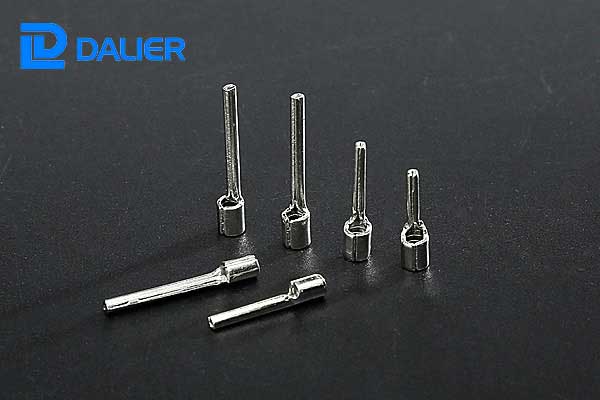
A non‑insulated terminals system serves a different purpose than its vinyl‑covered counterpart. The insulation is not on the terminal; it is provided by the terminal block housing, the PCB it plugs into, or the equipment enclosure. Dalier Electric’s Non-insulated pin terminal PTN is engineered specifically for that situation — a direct crimp‑on pin that fits into a terminal block or a PCB socket, leaving the insulation to the equipment, not the component. The PTN series uses high‑purity oxygen‑free copper with a tin‑plated finish, undergoes a 24‑hour salt spray test for corrosion resistance, and is available for wire gauges 22‑16 AWG (0.5‑1.5mm²) carrying up to 19A. This article explains why a non‑insulated pin terminal can outperform an insulated one in high‑density panels, how the butted seam barrel creates a gas‑tight crimp without crushing the conductor, and where the 24‑hour salt spray certification matters.
The clearance problem: why insulation that you cannot see reduces terminal density
Terminal blocks on industrial control panels are often designed to accept pin terminals at 5mm spacing. A fully insulated pin terminal with a vinyl sleeve adds 2‑3mm of width. When 50 such terminals are lined up in a row, the insulation volume reduces the effective working space by a significant margin.
The PTN non‑insulated pin terminal has no sleeve. The barrel is the terminal. The metal pin that inserts into the terminal block is the same width as the crimped barrel. No extra space is consumed.
A panel builder in the Netherlands replaced 1,200 insulated pin terminals with Dalier PTN non‑insulated pins across 20 control cabinets, reducing the required backplane width by a substantial amount and allowing the enclosures to be downsized to a smaller standard size.
Oxygen‑free copper and the butted seam: what the terminal’s material actually does for conductivity
Not all copper terminals are the same. The PTN series is stamped from oxygen‑free copper — a grade of copper where the oxygen content is reduced to nearly zero. Oxygen‑free copper has higher conductivity than standard copper and resists hydrogen embrittlement.
The butted seam barrel is formed by stamping a flat copper blank into a U‑shape, then closing the edges together. This creates a hollow cylinder with a single seam that runs the length of the barrel. When crimped, the seam closes completely, and the copper cold‑flows into a gas‑tight bond with the wire strands. The alternative, a brazed barrel, has a welded seam that can crack under vibration.
Why a gas‑tight crimp outlasts a soldered joint
A soldered wire connection can creep under thermal cycling. The solder softens, the wire moves, and the joint loosens. A gas‑tight crimp — like the one achieved in a PTN terminal — cold‑welds the copper strands together under pressure, creating a connection that will outlast the wire insulation. There is no softening, no thermal creep, and no loosening.
PTN specifications: from 0.5mm² to 1.5mm², 19A max
The PTN series is designed for the wire sizes most common in control panel and PCB wiring. The table below shows the key specifications.
| Wire Range (mm²) | AWG Equivalent | Max Current | Pin Diameter | Overall Length |
|---|---|---|---|---|
| 0.5‑1.5 | 22‑16 | 19A | 1.9mm | 13.8mm |
| Other sizes available upon request |
The terminal is suitable for terminal blocks that accept pin‑type terminations. The 19A current rating is based on the cross‑section of the oxygen‑free copper barrel and the tin‑plated surface finish. The 1.9mm pin diameter fits standard terminal block sockets.
Temperature and salt spray limits
The PTN series passes a 24‑hour salt spray test, assuring resistance to moisture and airborne salt found in coastal industrial environments and marine applications.
Three applications where a non‑insulated pin terminal is the only logical choice
Application one: Terminal blocks with integrated finger guards
A terminal block manufacturer designs the housing with a finger‑safe barrier around each termination point. The insulation is built into the block. Adding a vinyl‑sleeved pin terminal is redundant and consumes space. The non‑insulated terminals connect directly into the protected cavity with zero added width.
Application two: PCB header pins
A printed circuit board may use pin headers to receive wire‑to‑board terminations. The board is already conformal‑coated for insulation. The clearance between adjacent pins is fixed by the PCB design. A non‑insulated pin terminal is the only type that fits.
Application three: High‑volume control panel assembly
A panel builder who assembles hundreds of identical units each month values the inspectability of a non‑insulated terminal. The operator can see the copper strands fully inserted into the barrel before the crimp. After the crimp, the inspector can see the gas‑tight seal at the seam. An insulated terminal hides the wire insertion depth and the seam closure.
The crimp that a panel builder trusts: why the PTN design leaves room for visual inspection
An insulated terminal hides the critical elements. You cannot see the wire strands before you crimp — you feel them. You cannot see the barrel seam after you crimp — you trust the tool calibration.
The PTN non‑insulated pin terminal is open. The wire insertion depth is visible before crimping. The operator can confirm that the insulation has been stripped back by the correct amount and that the strands are fully seated inside the barrel.
After crimping, the inspection is also clear. The crimp indentations are visible on the barrel surface. The inspector can see that the barrel has closed uniformly and that the wire strands have cold‑flowed to fill the barrel interior.
A plant manager in Italy reported that after switching to non‑insulated pin terminals, his first‑pass yield improved substantially. The operators were no longer guessing whether the wire was seated correctly. They could see it.
How the PTN non‑insulated pin terminal fits into Dalier Electric’s terminal portfolio
Dalier Electric manufactures the PTN series as part of its non‑insulated terminal line, which includes ring terminals (SNB), spade terminals (SNB fork), blade terminals (DBN), butt splices, and pin terminals (PTN).
All non‑insulated terminals in the Dalier line share the same material specification: oxygen‑free copper, tin plating, butted seam construction, and 24‑hour salt spray testing.
The PTN series is sold in bulk packaging for panel builders and OEMs. The standard wire range is 0.5‑1.5mm² (22‑16 AWG) with a 19A current rating. The terminals are compatible with standard ratchet crimping tools with a nest for non‑insulated pin terminals.
For a non‑insulated terminals solution that fits 22‑16 AWG wire, carries 19A, and survives salt spray, Dalier’s PTN non‑insulated pin terminal delivers the clearance, inspectability, and crimp reliability that crowded control panels demand.
【Request a quote from Dalier Electric】
Contact Dalier Electric with your wire gauge (22‑16 AWG), required current rating, and annual volume for a PTN pin terminal quotation with a matched crimp tool recommendation.