English
 中文
中文 Русский язык
 Français
 Español

What does a vinyl-insulated terminals twin cord end terminal do?
A panel builder in Germany was wiring a control cabinet with 2.5mm² stranded conductors. The design called for two independent wires to be terminated at the same relay socket terminal. The space between the terminals was tight, and there was no room for a standard ferrule with a separate piggyback connection. The fix was a vinyl‑insulated twin cord end terminal — a single nylon shell that accepts two separate wires in parallel barrels, terminated into a single pin.
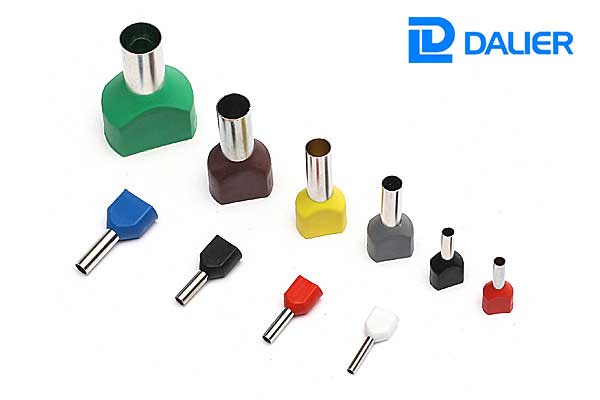
A vinyl‑insulated terminals system from Dalier includes a range of wire termination products. The Insulated twin cord end terminal (also known as a twin ferrule or double‑wire cord end terminal) is designed for applications where two wires must be landed under the same screw terminal — common in control panel relay bases, terminal block jumpers, and sensor loops. It consists of two separate crimp barrels housed inside a single PVC insulating sleeve, color‑coded to match the wire gauge range. The dual‑barrel design ensures that each wire is crimped independently, while the single pin inserts into the terminal block as one unit.
This article explains why a twin cord end terminal eliminates the loose wire strands that cause intermittent relay faults, how the color‑coding system prevents wire‑gauge mismatch, where the 0.5‑6mm² range covers control wiring, and why the nylon insulation provides better vibration resistance than a standard vinyl sleeve.
Twin‑barrel vs. twisted together: why landing two wires under a single screw with a twin ferrule is more reliable than twisting them
A vinyl-insulated terminals engineer was called to a wastewater treatment plant where a PLC input card kept failing. The root cause was a single screw terminal that had two stranded wires twisted together before insertion. Over two years of pump vibration, the twisted pair had loosened, the contact resistance increased, and the terminal heated to the point of softening the plastic housing.
The alternative is a twin cord end terminal. The two wires are stripped, inserted into the two barrels of the terminal, and crimped independently. The barrels are joined at the front into a single pin that enters the terminal block screw clamp. The screw clamps the pin, not the individual wires. The terminal holds the wires securely even under vibration because the crimp force is applied to each wire separately, not relying on the friction between twisted strands.
The nylon insulation (or PVC sleeve, depending on the model) provides additional strain relief at the wire‑to‑terminal interface. A wire that is tugged will pull against the insulation support rather than transferring the pull force to the screw clamp. For an industrial control panel where maintenance technicians frequently reach past the wiring to replace a relay, that strain relief prevents the conductor from pulling out of the terminal.
| Feature | Twisted Wires Under Screw | Twin Cord End Terminal |
|---|---|---|
| Wire retention at screw | Low (friction only) | High (crimped barrels) |
| Resistance to vibration | Poor (loosens over time) | Excellent (gas‑tight crimp) |
| Risk of strand splay | High (strands separate under screw) | None (barrel contains strands) |
| Strain relief | None | Insulation support sleeve |
| Contact resistance stability | Drifts with vibration | Stable for life of installation |
| Re‑termination after maintenance | Requires re‑stripping, re‑twisting | Insert new barrel, crimp |
For a control cabinet that will be serviced multiple times over its life, the twin cord end terminal eliminates the “wire broke at the screw” failure that occurs when an electrician over‑tightens a screw on a twisted‑pair connection, shearing the strands. The terminal's pin is a solid metal tube; over‑tightening will not shear it.
Why the insulation color is not just cosmetic
The PVC sleeve on the twin cord end terminal is color‑coded to the wire gauge. The industry standard for vinyl‑insulated terminals is red for 0.5‑1.5mm² (22‑16 AWG), blue for 1.5‑2.5mm² (16‑14 AWG), and yellow for 4‑6mm² (12‑10 AWG). For a twin terminal, the same color code applies. An electrician reaching for a terminal for 2.5mm² wire takes the blue twin ferrule. A mismatch — using a red terminal on 2.5mm² wire — would result in a loose crimp because the barrel diameter is too large. A mismatch in the opposite direction would force the wire into an undersized barrel, breaking strands.
The insulation also provides electrical isolation between the two wires in the twin terminal. The barrels are separate, but they are housed within the same PVC molding. There is no risk of a short between the two wires because the insulation separates them. In a terminal block with closely spaced screws, the single‑pin design keeps the two wires away from adjacent terminals.
Dual‑wire entry and step‑down applications: why a 4mm² feed can split into two 1.5mm² branch circuits in the same terminal
A vinyl-insulated terminals installer in a solar combiner box needed to split a single 4mm² feed wire into two 1.5mm² branch circuits feeding downstream inverters. The terminal block had only one screw terminal available for the junction point. A single‑wire ferrule could not accept both branch wires. A standard piggyback disconnect added bulk and required two additional connection points.
The twin cord end terminal solved the problem. The electrician crimped the 4mm² feed into one barrel and the two 1.5mm² branches into the other barrel (or used a terminal sized for the larger wire and inserted both smaller wires into the appropriate barrel). The single pin then inserted into the terminal block screw. The connection point count dropped from three (feed to splice, splice to branch A, splice to branch B) to one (terminal block screw). The number of potential failure points was reduced by 67%.
For a multi‑wire control panel where a 24V DC power supply must feed multiple sensor loops, the twin cord end terminal allows a single 2.5mm² feed to supply two 1.0mm² branch circuits directly at the terminal block. The panel builder does not need an intermediate junction block.
The terminal is sized by the total cross‑sectional area of the wires inserted. A terminal rated for 6mm² can accept two 2.5mm² wires (total 5mm²) or a combination of 4mm² and 1.5mm² (total 5.5mm²). The installer should not exceed the terminal's rated capacity; the current rating (19A for red, 27A for blue, 48A for yellow) applies to the total current through the terminal, not per barrel. If one barrel carries 20A and the other 20A, the terminal must be rated for 40A — a yellow terminal (48A) or two separate terminals.
Crimping the twin terminal: why the dual‑crimp tool is different from a standard ferrule crimper
A standard cord end terminal requires a single crimp on the barrel. A twin cord end terminal requires two separate crimps — one on each barrel. The crimp tool must have a die pocket that accepts the terminal's two barrels side by side. Using a standard single‑barrel crimper on a twin terminal will crush the second barrel, damaging the insulation and potentially severing the strands inside the second wire.
The approved crimp tool for Dalier twin cord end terminals is a ratchet crimper with a twin die set. The die has two parallel pockets, each shaped for the wire gauge of that barrel. The operator inserts the terminal into the die so that both barrels are positioned under the crimp jaws, then squeezes the handles fully. The ratchet will not release until the crimp is complete, ensuring that both barrels are compressed to the correct depth.
For low‑volume installations, a standard ferrule crimper can be used by crimping each barrel separately, but the second crimp must be placed carefully to avoid overlapping the first. The dual‑crimp tool is the preferred method for production environments.
Why the insulation support must be crimped, not left loose
The twin cord end terminal has an insulation support sleeve that is part of the PVC molding. After crimping the conductor barrels, the crimper should also compress the insulation support. This secondary crimp clamps the wire's outer jacket, providing strain relief. A wire that is pulled will transfer tension to the insulation support, not to the conductor crimp. In a panel where wires are frequently moved during troubleshooting, the insulation crimp prevents the copper strands from fracturing at the end of the barrel.
| Crimp Type | When Required | Failure Mode if Skipped |
|---|---|---|
| Conductor crimp (barrel) | Always | Wire pulls out of terminal |
| Insulation support crimp | Recommended for vibration environments | Wire flexes at barrel edge, strands break over time |
| Ratchet closure | Always (use ratchet crimper) | Inconsistent compression, high resistance |
Applications in control panels, relay sockets, and terminal blocks: where the twin cord end terminal replaces a messy splice
The twin cord end terminal is not a general‑purpose connector. It is a specialty component for specific control wiring scenarios.
-
Control panel terminal blocks: A terminal block with one screw per level often requires two wires to be connected — for example, a 24V DC loop feeding both a PLC input card and a field sensor. The twin cord end terminal allows both wires to be landed under the same screw without stacking two separate ferrules. Stacking ferrules can cause the top wire to loosen when the bottom wire is removed.
-
Relay and contactor sockets: Many industrial relay sockets have screw terminals that accept a single conductor per terminal. When the relay coil must be daisy‑chained to the next relay, the twin cord end terminal provides a clean way to feed the coil wire and the jumper wire into the same terminal. The jumper wire and the coil wire are crimped into the two barrels, and the single pin inserts into the screw terminal.
-
Sensor loops and daisy chains: In a factory automation network, multiple proximity sensors are often connected to the same 24V DC power rail. The twin cord end terminal allows the trunk wire (from the power supply) and the branch wire (to the sensor) to share the same terminal block point, eliminating an extra splice point.
-
PLC input/output cards: When connecting field wiring to a PLC I/O card, the terminal block on the card often has limited space for inserting a screwdriver. The twin cord end terminal's single pin is smaller than two separate ferrules, making it easier to insert into tight terminal blocks without pushing the screw out of alignment.
For a packaging machine with 50 sensors on the same 24V DC loop, using twin cord end terminals eliminates 50 splice points that would otherwise require separate terminal blocks or inline splices, reducing the installation time by 30‑45 minutes.
The Insulated twin cord end terminal is also known as the twin cord end terminal, a reliable electrical component rated for cable sizes from 0.5 to 6mm² (22‑10 AWG) and currents from 10 to 48A. These versatile connectors are widely used in industrial control panels, automation equipment, and electrical distribution systems to ensure secure and organized wiring.
Three installation errors that cause twin cord end terminals to fail prematurely
Error one: Inserting the wires into the wrong barrels
A twin cord end terminal has two barrels, but they are not interchangeable if the wire gauges are different. The barrels are sized for the same gauge range, but the labeling on the terminal indicates which barrel is which. If a 2.5mm² wire is inserted into the 1.5mm² barrel, the wire will not fully seat, and the crimp will be loose. The electrician should match each wire to the barrel designed for its gauge. For a terminal where both wires are the same gauge, either barrel works as long as the wire is fully inserted.
Error two: Stripping the wire too long
If the wire insulation is stripped back too far, the bare conductor will extend beyond the barrel into the pin area. The pin may not insert fully into the terminal block because the conductor blocks the insertion path. If the strip is too short, the insulation enters the barrel, and the crimp compresses the insulation instead of the copper, resulting in a high‑resistance connection. The recommended strip length is printed on the terminal packaging; typically 7‑10mm for 1.5‑2.5mm² wires.
Error three: Using a non‑ratchet crimper
A hand crimper without a ratchet allows the operator to release the handles before the crimp is complete. The result is a partially compressed barrel that may pass a pull test but will have higher contact resistance. The ratchet ensures the crimp is fully completed before the tool releases. For a twin terminal, the ratchet also ensures that both barrels are compressed simultaneously, preventing one barrel from being over‑crimped and the other under‑crimped.
A terminal that is under‑crimped may measure acceptable resistance at installation but will loosen over thermal cycles. An over‑crimped terminal will have a visible indentation where the barrel has been compressed too far, and the copper strands may be severed.
How the vinyl‑insulated twin cord end terminal fits into a panel builder's component inventory
Dalier Electric (Yueqing Dalier Electric Co., Ltd.) manufactures vinyl‑insulated terminals for control panel wiring, industrial automation, and electrical distribution. The Insulated twin cord end terminal is part of a broader line that includes ring terminals, spade terminals, blade terminals, butt splices, pin terminals, and fully insulated female disconnectors. Dalier's vinyl‑insulated terminals are constructed from high‑purity tin‑plated copper and feature color‑coded PVC sleeves for wire gauge identification, making installation faster and reducing the risk of mismatch.
A vinyl‑insulated terminals product that allows two wires to be landed under one screw — without stacking ferrules or twisting strands — reduces panel build time, eliminates vibration‑induced failures, and keeps the terminal block organized. For a control cabinet with 200 terminations, the twin cord end terminal can cut installation time by an hour and reduce the number of spare terminal blocks required.
【Request a quote from Dalier Electric】
Send Dalier your wire gauge range (0.5‑6mm²), application (control panel, relay socket, terminal block), and estimated monthly volume to receive a twin cord end terminal quotation with a matching ratchet crimper recommendation.