English
 中文
中文 Русский язык
 Français
 Español

Why does a maintenance electrician spend 10 minutes unscrewing ring terminals when a vinyl-insulated female disconnector could do the job in 10 seconds?
At 2 AM on a Sunday, a cold storage facility’s evaporator fan relay failed. The on‑call electrician arrived, opened the control panel, and spent 12 minutes: 5 minutes to identify the relay, 3 minutes to unscrew four ring terminals, and 4 minutes to screw the new relay’s terminals. Total downtime: 30 minutes including travel to the electrical room. The lost product from the warming freezer cost the operator US$4,000.
The same facility later switched to quick‑disconnect terminals. When the next relay failed, the electrician pulled four vinyl-insulated female disconnectors off the old relay, pushed them onto the new relay’s tabs, and closed the panel. Downtime for the repair: 90 seconds. The product loss was minimal.
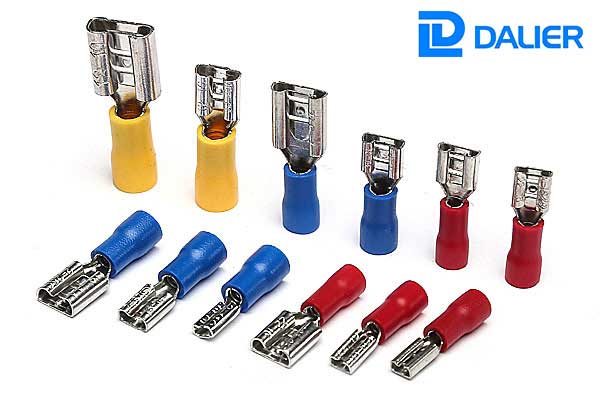
A vinyl-insulated terminals system that includes female disconnectors (FDD series from Dalier Electric) is designed for tab‑style relay, contactor, and switch terminals in widths of 2.8mm, 4.8mm, and 6.3mm. The disconnect eliminates the screw‑terminal step that consumes most of the repair time and reduces the risk of loose connections from undertorqued screws. This article compares the maintenance labour cost of screw‑down terminals versus push‑on disconnectors, explains how the spring‑tempered brass sleeve maintains contact pressure under vibration, and covers the three common tab sizes that match the FDD series colour codes.
Screw terminals vs. push‑on disconnects: the hidden labour cost of every ring terminal
Every electrical connection that uses a ring or spade terminal under a screw adds two steps to installation: aligning the terminal under the screw and torquing the screw to specification. When a component fails and must be replaced, those steps must be repeated. For a component with four terminals, the labour cost of unscrewing and rescrewing can exceed the cost of the component itself.
| Connection Type | Installation Time | Removal Time | Tool Required | Labour Cost per 100 Replacements (€100/hr shop rate) |
|---|---|---|---|---|
| Ring terminal (screw) | 2‑3 min per connection | 1‑2 min per screw | Screwdriver, torque tool | €500‑800 |
| Spade terminal (screw) | 1‑2 min per connection | 1 min per screw | Screwdriver | €300‑500 |
| Female disconnect (push‑on) | 5‑10 sec per connection | 2‑5 sec | None | €15‑30 |
The female disconnect’s advantage compounds when replacing devices with many terminals. A 4‑pole relay with ring terminals costs roughly €15 in labour every time it is swapped. The same relay with female disconnectors costs less than €0.50 in labour.
Dalier’s vinyl-insulated terminals FDD series cuts that labour cost by eliminating the screwdriver step entirely. The electrician pulls the old disconnect, pushes the new one, and moves on.
The spring‑tempered brass sleeve that holds tight under compressor vibration
A quick‑disconnect terminal does not rely on screw torque. Its holding force comes from a spring‑tempered brass sleeve inside the vinyl housing. When pushed onto a flat tab (2.8mm × 0.5mm, for example), the sleeve expands slightly and applies constant radial pressure. The tab’s edges engage with the sleeve’s internal geometry, creating a detent that resists pull‑off forces.
On a refrigeration compressor that cycles every 20 minutes, the vibration from the motor start‑stop can loosen screw terminals over weeks or months. A loose ring terminal may still pass continuity but will have higher resistance, heating the connection and eventually causing intermittent faults. The female disconnect’s spring‑tempered sleeve does not loosen, maintaining consistent contact pressure independent of vibration cycles.
Dalier’s FDD series uses purple copper (≥99.9% purity) for the sleeve, electro‑tin plated to prevent corrosion. The sleeve design includes a raised dimple that mates with a corresponding recess on the tab, providing anti‑rotation and a positive click when fully seated. The pull‑out force is specified as 5‑10 N for 4.8mm tabs – secure enough to stay attached under normal operation but not so tight that a technician struggles to remove it.
Why the flared PVC sleeve prevents accidental disconnection and wire fatigue
The vinyl sleeve of the FDD series extends beyond the metal barrel and flares at the opening. When fully seated, the flare contacts the base of the tab, giving both a visual and tactile indication of full engagement. The flare also acts as a stop, preventing over‑insertion that could damage the internal spring. Additionally, the sleeve’s rigidity resists side‑pull forces that would otherwise lever the disconnect off the tab.
The sleeve also provides strain relief at the crimp point. Without the vinyl support, the wire would bend sharply at the back of the metal barrel, work‑hardening the copper strands and eventually causing a break. The flared PVC distributes bending stress over a longer length, extending the service life of the crimp joint.
Colour‑coded sizes: matching the disconnect to the tab width and wire gauge
Female disconnectors are available in three nominal tab widths, each corresponding to a current‑carrying capacity and wire range. Dalier’s FDD series follows the standard colour code:
| Disconnect Colour | Tab Width (mm) | Wire Range (AWG) | Max Current | Typical Application |
|---|---|---|---|---|
| Red | 2.8 | 22‑16 (0.5‑1.5mm²) | 19A | Relays, timers, micro switches |
| Blue | 4.8 | 16‑14 (1.5‑2.5mm²) | 27A | Contactors, motors, fans, automotive |
| Yellow | 6.3 | 12‑10 (4‑6mm²) | 48A | Power relays, circuit breakers |
The colour code matches the wire gauge convention, reducing the chance of mismatch. A blue disconnect is sized for 16‑14 AWG wire and a 4.8mm tab. Using a blue disconnect on a 2.8mm tab will result in a loose fit; using it on a 6.3mm tab will be impossible. The colour code prevents this error if the electrician follows the wire gauge.
For an OEM building control panels, colour coding also speeds up assembly. A worker on a line sees a red wire (0.5‑1.5mm²) and reaches for a red disconnect without checking a drawing.
Quick disconnects in control panels: the UL 508A allowance for field replacement
Under UL 508A (industrial control panel standard), components such as relays, contactors, and terminal blocks may use quick‑connect terminals as the primary connection method. The standard does not require screw terminals for field‑replaceable devices. A panel built with female disconnectors on all relay bases allows a maintenance electrician to swap a failed relay without touching a screwdriver.
For a panel builder, using female disconnectors reduces assembly time. The builder crimps disconnectors onto wires at the bench, then pushes them onto relay tabs during panel assembly. No screw‑torquing, no alignment, no dropped screws.
Dalier’s vinyl-insulated terminals (主词加粗第3次) FDD series is rated for 105°C continuous operation, matching the temperature rating of standard control panel wiring (THHN/THWN). The PVC insulation is UL94 V‑2 or V‑0 rated for flammability, meeting panel certification requirements.
Three field replacement scenarios where a female disconnect saves hours
Scenario one: Replacing a failed fan relay in an air handler
A rooftop HVAC unit has a fan relay with four terminals. With ring terminals, the technician must open the control panel, label the wires, unscrew four screws, remove the relay, install the new relay, re‑insert the ring terminals, and torque the screws. The job takes 20‑25 minutes. With female disconnectors, the technician pulls four disconnects, swaps the relay, pushes the disconnects onto the new tabs, and closes the panel. Total: 5 minutes. For a supermarket with 20 rooftop units, the annual maintenance saving is significant.
Scenario two: Diagnosing an intermittent conveyor fault
A conveyor motor stops randomly. The technician suspects a loose connection at the motor starter. With ring terminals, they must de‑energize the panel, unscrew each terminal, inspect, retorque, and re‑energize. With female disconnectors, they de‑energize, pull off each disconnect, inspect the tab and sleeve corrosion, reseat, and re‑energize. The difference is not just time; the disconnect allows a quick pull‑and‑reseat that can clean a lightly corroded tab without tools.
Scenario three: Retrofitting a legacy panel without rewiring
An old panel uses screw‑terminal relays that are no longer available. The replacement relay has quick‑connect tabs. The electrician cuts the ring terminals off the existing wires, crimps on female disconnectors, and pushes them onto the new relay. The retrofit takes 10 minutes per relay instead of 2 hours for a full rewire.
The anti‑rotation feature that prevents wire twist fatigue
Inside the vinyl sleeve, the metal barrel of the Dalier FDD series includes a raised dimple or a flattened side that mates with the tab’s orientation. This anti‑rotation feature prevents the disconnect from spinning on the tab when the wire is moved. Without anti‑rotation, a wire that is tugged or twisted would rotate the disconnect on the tab, eventually loosening the crimp or work‑hardening the copper strands.
The anti‑rotation dimple is sized to match the tab’s locking recess. When the disconnect is fully seated, the dimple clicks into place, providing tactile feedback to the installer. For applications where the wire is subject to movement (e.g., a motor lead that flexes during operation), the anti‑rotation feature is essential for long‑term reliability.
[Image: Close‑up of the Dalier vinyl-insulated female disconnector being pushed onto a 6.3mm tab on a power relay, showing the flared PVC sleeve and the anti‑rotation dimple engagement]
How the Dalier FDD vinyl‑insulated female disconnector fits into a preventive maintenance program
Yueqing Dalier Electric Co., Ltd. manufactures the FDD series as part of its full line of vinyl-insulated terminals (主词加粗第4次), including ring, spade, blade, piggyback, pin, and butt splice terminals. The FDD series is available in 2.8mm, 4.8mm, and 6.3mm tab sizes, colour‑coded red, blue, yellow, with wire ranges 0.5‑1.5mm² (22‑16 AWG), 1.5‑2.5mm² (16‑14 AWG), and 4‑6mm² (12‑10 AWG).
The internal sleeve is stamped from high‑purity purple copper (≥99.9%) and electro‑tin plated. The PVC sleeve is flared for easy tab insertion, double‑insulated to prevent flashover, and rated for 105°C. Dalier supplies the FDD series in bulk pack (100‑500 pieces) or continuous strip form for automated applicators.
For a vinyl-insulated terminals programme that reduces equipment swap time from 10 minutes to 10 seconds, the FDD series female disconnector delivers colour‑coded sizing, vibration‑resistant spring grip, anti‑rotation dimple, and UL‑rated insulation that keeps control panels running through the night shift.
[Request a quote from Dalier Electric]
Contact Dalier Electric with your required tab width (2.8mm, 4.8mm, or 6.3mm), wire gauge, and estimated monthly usage for a female disconnector quotation with matching crimp tool recommendation.