English
 中文
中文 Русский язык
 Français
 Español

How to Choose the Right Vinyl-Insulated Terminals for Your Wiring?
You're standing in front of a panel, wire in hand, trying to figure out which terminal you need. Ring? Spade? Blade? Disconnect? They all look similar. They all do the same basic job. But using the wrong one means a connection that fails under vibration, or a terminal that's impossible to remove when you need to service the equipment. A vinyl-insulated terminals is a simple component—a metal connector wrapped in plastic. Most equipment in the industrial field will be suitable for these terminals. But the choice of terminal type determines how reliable that connection will be, how easy it is to maintain, and whether it survives the environment it's installed in. This guide breaks down the most common types—ring, spade, blade, and disconnect—and shows you how to choose the right one for your application.
Ring Terminals – The Connection That Stays Put
Ring terminals are the workhorse of permanent electrical connections. If you need a connection that won't come loose, this is the terminal you choose. A ring terminal has a circular ring at the end that completely encircles the stud or screw. Even if the nut loosens, the ring stays in place—the connection remains intact.
Sizes and Current Ratings
Dalier's ring terminals are engineered for cable sizes between 0.5–1.5mm² (22–16 AWG) and handle currents up to 19A. The vinyl insulation is color-coded—red for 22–16 AWG, blue for 16–14 AWG, yellow for 12–10 AWG—making it easy to match the terminal to the wire gauge.
When to Use a Ring Terminal
Use a ring terminal for permanent connections that should never come loose—grounds, motor leads, power distribution, and any connection subject to vibration. If you're making a connection that you don't plan to disconnect regularly, ring terminals are the right choice.
Spade Terminals – The Connector You Can Remove
Spade terminals are designed for connections that need to be disconnected periodically. They slide onto a stud or screw and can be removed without loosening the fastener.
The Fork That Slides On and Off
A spade terminal has a fork-shaped end that slides onto a stud or screw. To disconnect, you simply pull it off—no tools required. This makes spade terminals the standard for test points, service connections, and any circuit that's regularly disconnected.
Spade vs. Ring – The Trade-Off
The spade terminal is more convenient than a ring terminal, but it's more likely to loosen under vibration. For applications where vibration is minimal and service access is frequent, spade terminals are the practical choice. For high-vibration environments, use a ring terminal.
Blade and Disconnect Terminals – Quick Connections for Frequent Changes
Blade terminals and disconnect terminals are designed for connections that are made and broken frequently.
Blade Terminals – Flat and Secure
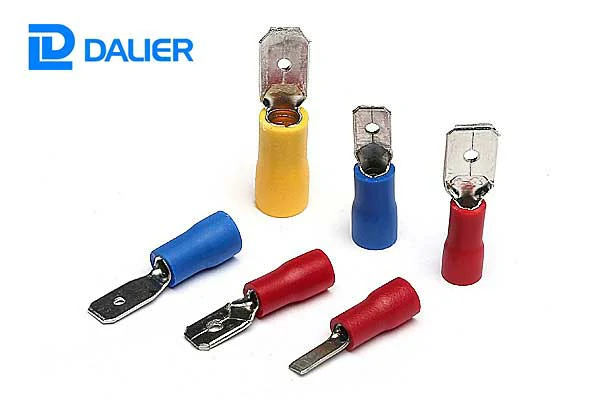
Vinyl-insulated blade terminals are engineered for cable sizes between 0.5–1.5mm² (22–16 AWG) and handle up to 19A. The flat blade slides into a female receptacle, creating a secure connection that can be disconnected quickly. Blade terminals are common in automotive fuse blocks and relay sockets.
Female and Male Disconnects – The Plug-and-Play Connector
Female disconnect terminals (FDD) and male disconnect terminals are designed for applications where equipment needs to be swapped quickly. A vinyl-insulated female disconnector can cut equipment swap time from minutes to seconds.
Open Barrel Terminals – A Different Approach to Crimping
Open barrel terminals use a different design philosophy than traditional closed-barrel terminals. The open-end barrel design permits visual inspection of wire placement prior to crimping. This means you can confirm the wire is fully inserted before applying the crimp tool—reducing the risk of poor connections.
Visual Inspection Before Crimping
With a closed barrel, you have to trust that the wire is fully inserted. With an open barrel, you can see it. This simple difference reduces the most common cause of terminal failure: wires that aren't fully seated in the barrel.
When to Choose Open Barrel
Open barrel terminals are particularly useful in high-volume production environments where consistency matters. They're also a good choice when training new assemblers—the visual confirmation helps catch errors before they become failures.
Where Vinyl-Insulated Terminals Fit Best
Terminals are everywhere in industrial wiring, but not every terminal fits every application. Knowing where each type belongs saves time and prevents failures.
Motor Controls and Power Distribution
Vinyl-insulated terminals are the standard for connecting wires to contactors, relays, and terminal blocks in motor control centers and power distribution panels. The color coding—yellow for 12-10 AWG, blue for 16-14 AWG, red for 22-16 AWG—makes wire identification fast and error-proof.
HVAC Systems and Industrial Machinery
HVAC equipment uses terminals for compressor connections, control wiring, and power supply connections. The vibration from motors and compressors demands terminals that hold tight. Ring tongue and spade terminals are common here, with quick-disconnect terminals used where service access is frequent.
Where They Don't Fit
Vinyl insulation has a temperature limit—typically around 105°C. For high-heat applications like furnace controls or engine compartments, you need terminals with different insulation materials—nylon or heat-shrink tubing. Vinyl-insulated terminals also aren't suitable for direct burial or continuous water immersion.
| Terminal Type | Best Use | Trade-Off |
|---|---|---|
| Ring | Permanent connections subject to vibration | Harder to remove |
| Spade | Test points, service connections | Can loosen under vibration |
| Blade/Disconnect | Frequent disconnection | Less secure than ring |
| Open Barrel | Production, visual verification | Requires different crimp tool |
What Engineers Ask About Vinyl-Insulated Terminals
What is the temperature limit for vinyl-insulated terminals?
Vinyl insulation has a temperature limit of approximately 105°C. For higher-temperature applications, use nylon-insulated or heat-shrink terminals.
What is the difference between a ring terminal and a spade terminal?
A ring terminal has a circular ring that completely encircles the stud—it stays in place even if the nut loosens. A spade terminal has a fork-shaped end that slides on and off without loosening the fastener.
What do the colors mean on vinyl-insulated terminals?
Red indicates 22–16 AWG (0.5–1.5mm²), blue indicates 16–14 AWG (1.5–2.5mm²), and yellow indicates 12–10 AWG (4–6mm²).
What is an open barrel terminal?
An open barrel terminal has a barrel design that permits visual inspection of wire placement prior to crimping. This reduces the risk of poor connections from wires that aren't fully seated.
Need the Right Terminal for Your Wiring? Let's Match It
Selecting a vinyl-insulated terminal comes down to three factors: terminal type (match your connection need), wire gauge (match your cable), and environment (match your temperature and vibration conditions). Contact Dalier for technical support and samples → —their team can help you select the right terminal for your specific application.
Dalier Electrical manufactures vinyl-insulated terminals for industrial and commercial applications. The product line includes ring tongue, spade, butt splice, and quick-disconnect terminals in a range of sizes and colors. Dalier's terminals are engineered for cable sizes between 0.5–1.5mm² (22–16 AWG) and handle currents up to 19A. The vinyl insulation is color-coded for easy wire gauge identification. Applications include motor controls, power distribution, HVAC systems, and industrial machinery. Dalier provides comprehensive technical support, samples, and after-sales service. Connect with Dalier to discuss your terminal type requirements, wire gauge specifications, and environmental conditions.