English
 中文
中文 Русский язык
 Français
 Español

Why Vinyl-Insulated Butt Splice Terminal Fails?
A bottling plant loses an entire shift because a sensor keeps dropping out. The maintenance team replaces the sensor, checks the PLC, and rewires the cabinet—only to find that a single butt splice terminal had been loose for months. A Vinyl-Insulated Terminals connection that fails rarely announces itself with smoke or sparks. Instead, it causes intermittent dropouts, gradual heating, or eventual meltdown that can take hours to trace. The difference between a splice that lasts the life of the equipment and one that fails in months comes down to four root causes: wire gauge mismatch, incorrect strip length, improper crimping, and environmental overstress. This guide covers how to identify each failure, how to prevent it, and why Dalier‘s butt splice terminals are engineered to eliminate common field errors.
Wrong Wire Gauge – The Most Common Mistake
A Vinyl-Insulated Terminals product is designed for a specific wire range. Use a terminal rated for 16‑14 AWG on an 18 AWG wire, and the crimp will not compress enough to hold the wire securely. Use the same terminal on a 12 AWG wire, and the wire will not fit into the barrel at all—or will be forced in, damaging the strands.
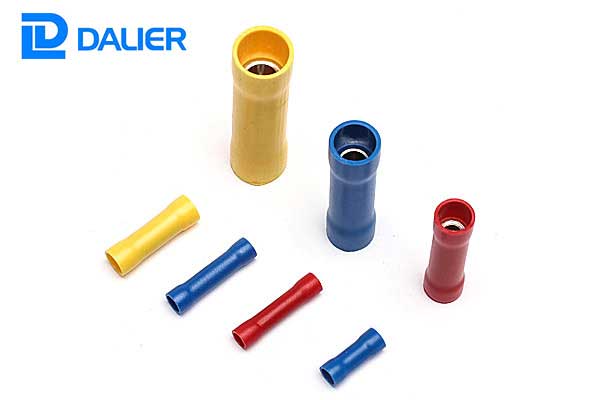
Color‑coding prevents mismatch. The industry standard color code is simple and reliable: Red for 22‑18 AWG (0.5‑1.0 mm²), Blue for 16‑14 AWG (1.5‑2.5 mm²), and Yellow for 12‑10 AWG (4‑6 mm²). Dalier butt splice terminals follow this standard. A mismatch between wire gauge and terminal rating causes melted insulation—the most visible sign of failure. Always match the terminal‘s AWG rating to your wire size before crimping.
What happens when you mismatch. If you crimp an undersized wire in a larger terminal, the barrel does not deform enough to grip the wire. The connection relies on friction rather than a gas‑tight mechanical bond. Over time, vibration loosens the joint, resistance rises, and heat builds until the insulation melts.
Poor Strip Length – Too Long or Too Short
Strip length is the second most common error. The correct strip length exposes enough conductor to fill the terminal barrel without leaving bare wire visible outside the insulation. For Dalier butt splice terminals, strip approximately 6‑8 mm (1/4 inch) of insulation from each wire end. If you strip too much, bare conductor protrudes beyond the barrel, creating a potential short circuit path or corrosion entry point. If you strip too little, the wire insulation enters the barrel, preventing the conductor from contacting the full length of the metal tube—the crimp compresses plastic instead of copper, creating a high‑resistance connection that overheats. The internal wire stop in properly designed butt splice terminals ensures that the wire is inserted into the terminal barrel at the proper length, with the insulation butting against the barrel end. Always use a calibrated wire stripper, not a pocket knife or side cutter, to avoid nicking the copper strands.
Crimp Force – Too Little or Too Much
The terminal’s barrel is designed to be compressed around the wire strands using a specific crimping tool. Crimping with pliers, a hammer, or the wrong die size produces an unreliable connection.
Too little force. If the crimp does not compress the barrel sufficiently, the wire can pull out with minimal force. The connection will feel loose when wiggled. Over time, the intermittent contact creates arcing that carbonizes the insulation. Internal barrel serrations are designed to grip wires tightly to resist pull‑out and reduce electrical resistance—but they only work if the barrel is fully compressed.
Too much force. Over‑crimping can split the barrel (especially in butted‑seam designs) or crush the wire strands, reducing the effective cross‑section and creating a mechanical weak point. Use a ratcheting crimping tool with color‑coded dies that match the terminal size. A ratcheting tool applies the correct amount of compression and does not release until the full crimp cycle is complete, eliminating operator variability.
The barrel seam matters. Dalier‘s butt connector terminals are crafted from tin‑plated brass for superior conductivity. Their shouldered barrel insulation quickly positions the terminal for proper crimping. Expanded insulation entry accommodates a wide variety of insulation diameters and provides additional insulation support—reducing the risk of insulation being drawn into the crimp zone.
Environmental Overstress – Heat, Cold, and Chemicals
Even a perfectly installed Vinyl-Insulated Terminals connection can fail if the operating environment exceeds the material‘s limits. Vinyl insulation is rated for continuous operation from ‑40°C to +105°C. Above 105°C, the vinyl softens, deforms, and loses its dielectric properties. Below ‑40°C, the material becomes brittle and may crack. In automotive engine compartments or near industrial heat sources, temperature can easily exceed 105°C. In such cases, specify nylon‑insulated terminals, which withstand higher temperatures (up to 125‑150°C). For marine or outdoor applications where moisture and salt are present, the tin‑plated brass conductor resists corrosion, but the vinyl insulation still provides the primary environmental seal. For applications requiring direct burial or submersion, consider heat‑shrink or epoxy‑filled terminals instead. Dalier offers both vinyl and nylon insulation options to match different environmental requirements.
Correct Crimping Procedure – Step by Step
Step 1 – Select the correct terminal. Match the terminal‘s color (red/blue/yellow) to your wire gauge. Do not guess.
Step 2 – Strip the wire. Use a wire stripper to remove 6‑8 mm (1/4 inch) of insulation. Inspect the exposed conductor for nicks or missing strands. Do not use a damaged wire.
Step 3 – Insert the wire. Push the stripped wire into the terminal barrel until the insulation butts against the barrel end. The conductor should fill the full length of the barrel. For butt splices, repeat on the other end with the second wire.
Step 4 – Crimp with the correct tool. Use a ratcheting crimper with a die matching the terminal color. Position the terminal in the die so that the crimp is centered on the barrel. Squeeze until the ratchet releases. Do not crimp the insulation sleeve—only the metal barrel.
Step 5 – Pull test. After crimping, tug firmly on each wire. The wire should not pull out. If it does, cut off the terminal and start over. Do not attempt to re‑crimp.
Step 6 – Inspect. The crimp should be symmetrical, with no visible cracks or sharp edges. The wire insulation should be flush with the barrel end, not inside the barrel.
Questions from Maintenance Electricians
Q: Why does my butt splice terminal get hot even though it passed a pull test? A: High resistance inside the crimp generates heat. The most common cause is a wire gauge mismatch—using a terminal rated for 16‑14 AWG on 18 AWG wire. The crimp feels tight, but the barrel does not compress enough to create a gas‑tight seal. Measure the temperature with an infrared thermometer after running current; if it exceeds the ambient temperature by more than 15‑20°C, replace the connection. A vinyl‑insulated terminals mismatch between wire gauge and terminal rating causes melted insulation, which is a clear sign of thermal failure.
Q: Can I reuse a crimped butt splice terminal after removing the wire? A: No. Once crimped, the barrel is permanently deformed. Re‑crimping a used terminal will not achieve the required compression force, and the connection will be unreliable. Cut off the old terminal and install a new one.
Q: What is the difference between vinyl and nylon insulation? A: Vinyl is economical, flexible, and rated up to 105°C. Nylon has a higher temperature rating (125‑150°C), better abrasion resistance, and superior chemical resistance. For engine compartments, industrial ovens, or high‑temperature environments, choose nylon. For general electrical work, vinyl is sufficient.
Q: How can I tell if a butt splice terminal is UL listed? A: Look for the UL mark on the packaging or product datasheet. Dalier‘s seamless butt splices meet UL standards and feature high‑purity copper construction. UL listing ensures the terminal has passed rigorous testing for current‑carrying capacity, dielectric strength, and flame resistance.
Dalier‘s Approach to Reliable Vinyl-Insulated Terminals
When a wiring connection must hold for years in automotive, marine, or industrial environments, the quality of the terminal determines whether the connection outlasts the equipment or becomes a recurring failure point. Yueqing Dalier Electric Factory specializes in designing and developing wiring terminals, connectors, cable lugs, contactors, and thermal relays. The company offers a complete range of Vinyl-Insulated Terminals, including ring terminals, spade terminals, butt splice connectors, disconnects, and cord end terminals.
Dalier‘s butt splice terminals are crafted from tin‑plated brass for superior conductivity and corrosion resistance. The insulation is color‑coded for easy identification—red (22‑18 AWG), blue (16‑14 AWG), and yellow (12‑10 AWG)—and rated for a maximum temperature of 105°C. The butted‑seam barrel construction prevents splitting under maximum pressure, and internal barrel serrations grip wires tightly to resist pull‑out and reduce electrical resistance. Expanded insulation entry accommodates a wide variety of insulation diameters and provides additional insulation support, reducing the risk of mis‑crimping.
Dalier‘s twin cord end terminals cover 0.5‑6 mm² (22‑10 AWG), and the company’s product line is used in automotive systems, home appliances, and industrial equipment. For procurement teams and maintenance departments, stocking Dalier‘s color‑coded vinyl‑insulated terminals simplifies inventory management and reduces the risk of wire‑gauge mismatch in the field.
[Image: Dalier butt splice terminals in red, blue, and yellow color‑coded insulation with tin‑plated brass barrels visible]
→ Request a quote from Dalier for butt splice terminals — Share your wire gauge range (22‑18 AWG, 16‑14 AWG, or 12‑10 AWG), preferred insulation type (vinyl or nylon), and estimated monthly volume. Their technical team can recommend the right terminal configuration and provide color‑coded samples for testing.