English
 中文
中文 Русский язык
 Français
 Español

Where Do Vinyl-Insulated Terminals Fit Best?
You've opened a control panel to trace a fault and found it. A rat's nest of daisy-chained wires, terminals that don't quite fit, and insulation that's cracked from age or heat. Somewhere in that mess is the connection that's failing—but finding it means tracing through a dozen terminals that all look the same.
A vinyl-insulated terminal looks simple—a metal connector wrapped in colored plastic. But the simplicity is deceptive. The difference between a terminal that lasts for years and one that fails in months is not just the material—it's whether you used the right terminal in the right place. Dalier Electrical's piggy-back disconnector PBDD is a vinyl-insulated quick-disconnect terminal that solves a specific problem: how to connect multiple wires to a single termination point without compromising reliability. This guide covers where vinyl-insulated terminals fit best, how to choose the right type for your application, and what to avoid.
Where vinyl-insulated terminals go — and where they don't
Terminals are everywhere in industrial wiring, but not every terminal fits every application. Knowing where each type belongs saves time and prevents failures.
Motor controls and power distribution
Most equipment in the industrial field will be suitable for vinyl-insulated terminals. They're the standard for connecting wires to contactors, relays, and terminal blocks in motor control centers and power distribution panels. The color coding—yellow for 12-10 AWG, blue for 16-14 AWG, red for 22-16 AWG—makes wire identification fast and error-proof.
HVAC systems and industrial machinery
HVAC equipment uses terminals for compressor connections, control wiring, and power supply connections. The vibration from motors and compressors demands terminals that hold tight. Ring tongue and spade terminals are common here, with quick-disconnect terminals used where service access is frequent.
The piggy-back's place — tight control panels
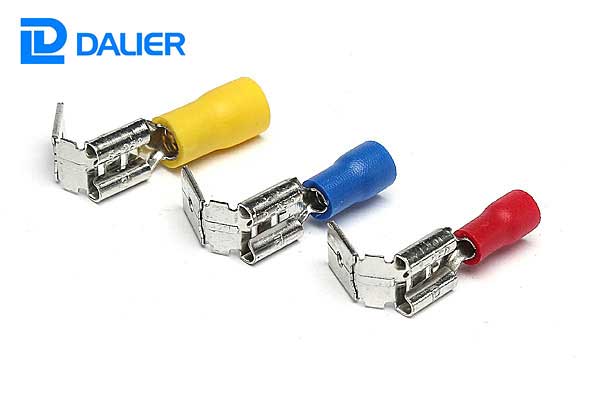
The piggy-back disconnector PBDD solves a specific problem: how to connect multiple wires to a single termination point. In tight control panels where space is limited, daisy-chaining adds failure points. The piggy-back lets you stack a second terminal onto the first, giving you two connections at one point without daisy-chaining. Cleaner layout, fewer failure points, easier troubleshooting.
Where they don't fit
Vinyl insulation has a temperature limit—typically around 105°C. For high-heat applications like furnace controls or engine compartments, you need terminals with different insulation materials—nylon or heat-shrink tubing. Vinyl-insulated terminals also aren't suitable for direct burial or continuous water immersion.
Choosing the right terminal for the job
Not every terminal type works in every application. Match the terminal to the connection need.
Ring tongue — permanent connections that stay tight
Ring tongue terminals are the go-to for connections that should never come loose. The ring wraps completely around the stud, so even if the nut loosens, the terminal stays in place. Use them for ground connections, motor leads, and any connection subject to vibration. For permanent connections where reliability is critical, ring tongue is the right choice.
Piggy-back disconnector — two connections in one spot
The piggy-back disconnector PBDD is a quick-disconnect terminal that lets you stack a second terminal onto the first. Use it when you need to connect two wires to one termination point—and when you might need to disconnect one without disturbing the other. Common in control panels where space is tight and multiple signals share a single termination point.
Spade and quick-disconnect — frequent service access
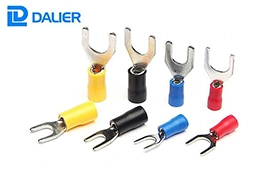
Spade terminals and quick-disconnects are designed for connections that need to be removed periodically. Use them for test points, service connections, or any circuit that's regularly disconnected. The trade-off is that they're more likely to loosen under vibration than ring tongue terminals—so use them where that trade-off is acceptable.
Below is a quick reference table for terminal types and their best applications:
| Terminal Type | Best Use | When to Use |
|---|---|---|
| Piggy-back disconnector | Multiple connections to one point | Control panels, signal wiring |
| Ring tongue | Permanent connections | Grounds, motor leads, vibration areas |
| Spade | Connections needing removal | Test points, service connections |
| Butt splice | Joining wires end-to-end | Wire repairs, extensions |
| Quick disconnect | Frequent connect/disconnect | Test equipment, modular wiring |
The mistakes that cause failures
Most terminal failures are preventable. Here's what to watch for.
Wrong terminal for the wire gauge
A terminal that's too large won't crimp properly. Too small and the wire won't fit. The color coding helps—yellow for 12-10 AWG, blue for 16-14 AWG, red for 22-16 AWG—but always verify the gauge before crimping. A terminal on the wrong gauge wire is a connection waiting to fail.
Wrong terminal for the connection type
Use a ring tongue for connections that shouldn't come loose. Use a quick-disconnect where frequent removal is needed. Using the wrong type creates either a connection that fails under vibration or a connection that's unnecessarily difficult to remove.
Wrong terminal for the environment
Vinyl insulation is rated for standard industrial temperatures. In high-heat areas, vinyl cracks and fails. In wet areas, standard terminals corrode. Match the terminal material to the environment.
Questions from the field
Q: What's the advantage of a piggy-back disconnector over a standard quick-disconnect?
A: A piggy-back disconnector lets you stack a second terminal onto the first, giving you two connections at one termination point. A standard quick-disconnect accepts only one wire. If you need to connect multiple wires, a piggy-back eliminates the need for daisy-chaining or splices, reducing failure points and simplifying panel layout.
Q: How do I know if a terminal is the right quality?
A: Look for even insulation thickness, consistent color, and a terminal barrel that's smooth and free of burrs. Check that the terminal accepts the wire gauge it claims. High-quality terminals crimp cleanly and hold the wire securely. Cheap terminals often have thin or uneven insulation, or terminal barrels that don't crimp properly.
Q: Can I use vinyl-insulated terminals in high-temperature environments?
A: Vinyl insulation has a temperature limit—typically around 105°C. For higher temperatures, you need terminals with different insulation materials, such as nylon or heat-shrink tubing. Check the terminal's temperature rating before using it in high-heat applications.
How Dalier Electrical helps you get the right terminal
Dalier Electrical manufactures vinyl-insulated terminals for industrial and commercial applications. The piggy-back disconnector PBDD is part of a comprehensive terminal line that includes ring tongue, spade, butt splice, and quick-disconnect terminals in a range of sizes and colors.
The company's terminals are designed for reliable connections that stand up to vibration, temperature cycling, and industrial environments. Whether you're building control panels, maintaining motor controls, or wiring industrial equipment, having access to the right terminal for the job is essential.
Before you place your next terminal order, review your applications. Are you connecting multiple wires to a single point? The piggy-back design solves a problem that daisy-chaining can't. Are you making permanent connections? Ring tongue is the right choice. Match the terminal to the application—and avoid the failures that come from using the wrong type in the wrong place.
Need vinyl-insulated terminals for your next project? Contact Dalier Electrical for a quote or sample request on the piggy-back disconnector PBDD. Share your application type, wire gauge range, and quantity—their team can recommend the right terminals for your specific needs.