English
 中文
中文 Русский язык
 Français
 Español

Which Vinyl-Insulated Terminal for Your Wire?
You're standing in front of a panel, wire in hand, trying to figure out which terminal you need. Ring? Spade? Blade? Disconnect? They all look similar. They all do the same basic job. But using the wrong one means a connection that fails under vibration, or a terminal that's impossible to remove when you need to service the equipment.
A vinyl-insulated terminal is a simple component — a metal connector wrapped in plastic. But the choice of terminal type determines how reliable that connection will be, how easy it is to maintain, and whether it survives the environment it's installed in. This guide breaks down the most common vinyl-insulated terminal types — ring, spade, blade, and disconnect — and shows you how to choose the right one for your application.
Ring terminals — the connection that stays put
Ring terminals are the workhorse of permanent electrical connections. If you need a connection that won't come loose, this is the terminal you choose.
The ring that wraps around the stud
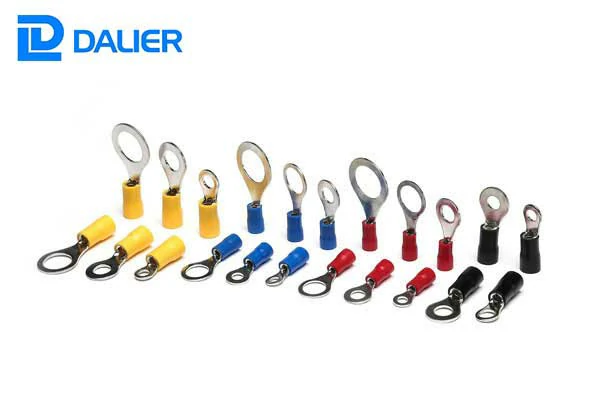
A ring terminal has a circular ring at the end that completely encircles the stud or screw. Even if the nut loosens, the ring stays in place — the connection remains intact. This makes ring terminals the standard for grounding connections, motor leads, and any connection subject to vibration.
Sizes and current ratings
Dalier's ring terminals are engineered for cable sizes between 0.5–1.5mm² (22–16 AWG) and handle currents up to 19A. The vinyl insulation is color-coded — red for 22–16 AWG, blue for 16–14 AWG, yellow for 12–10 AWG — making it easy to match the terminal to the wire gauge.
When to use a ring terminal
Use a ring terminal for permanent connections that should never come loose — grounds, motor leads, power distribution, and any connection subject to vibration. If you're making a connection that you don't plan to disconnect regularly, ring terminals are the right choice.
Spade terminals — the connector you can remove
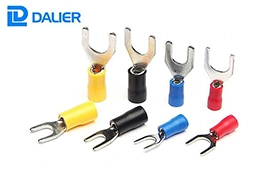
Spade terminals are designed for connections that need to be disconnected periodically. They slide onto a stud or screw and can be removed without loosening the fastener.
The fork that slides on and off
A spade terminal has a fork-shaped end that slides onto a stud or screw. To disconnect, you simply pull it off — no tools required. This makes spade terminals the standard for test points, service connections, and any circuit that's regularly disconnected.
Spade vs. ring — the trade-off
The spade terminal is more convenient than a ring terminal, but it's more likely to loosen under vibration. For applications where vibration is minimal and service access is frequent, spade terminals are the practical choice. For high-vibration environments, use a ring terminal.
When to use a spade terminal
Use a spade terminal for test points, service connections, and any circuit that's regularly disconnected. If you need to remove the connection periodically for testing or maintenance, the spade terminal saves time and eliminates the need for tools.
Blade and disconnect terminals — quick connections for frequent changes
Blade terminals and disconnect terminals are designed for connections that are made and broken frequently.
Blade terminals — flat and secure
Vinyl-insulated blade terminals are engineered for cable sizes between 0.5–1.5mm² (22–16 AWG) and handle up to 19A. The flat blade slides into a female receptacle, creating a secure connection that can be disconnected quickly. Blade terminals are common in automotive fuse blocks and relay sockets.
Female and male disconnects — the plug-and-play connector
Female disconnect terminals (FDD) and male disconnect terminals (MDD) are designed for cable sizes 0.5–1.5mm². They create a quick-connect, quick-disconnect connection that's ideal for applications where components need to be replaced or serviced regularly. Dalier offers both fully insulated and partially insulated versions.
When to use blade and disconnect terminals
Use blade terminals and disconnects for automotive applications, relay sockets, and any connection that needs to be made and broken frequently. If you're assembling a system that requires modular components, these terminals provide the flexibility you need.
Questions electrical professionals ask
Q: What's the difference between a ring terminal and a spade terminal?
A: A ring terminal has a circular ring that completely encircles the stud — it stays in place even if the nut loosens. A spade terminal has a fork-shaped end that slides onto the stud — it's easier to remove but can loosen under vibration. Choose ring for permanent connections, spade for connections that need periodic removal.
Q: How do I know which terminal size I need?
A: Match the terminal to your wire gauge. Dalier's terminals are color-coded — red for 22–16 AWG, blue for 16–14 AWG, yellow for 12–10 AWG. The terminal barrel must match the wire size for a proper crimp. Using a terminal that's too large won't crimp properly; too small won't accept the wire.
Q: What materials are vinyl-insulated terminals made from?
A: High-quality terminals use high-purity brass contacts with tin plating for low contact resistance and corrosion protection. The insulation is made from vinyl (PVC) or nylon, color-coded for easy identification, and flame-retardant for safety. Dalier's terminals also use nylon 66, 94V-2 rated for fire resistance.
Q: What is the temperature rating for vinyl-insulated terminals?
A: Vinyl-insulated terminals have a maximum temperature of 105°C. For higher temperature applications, nylon-insulated terminals are available with higher temperature ratings. Always check the terminal's temperature rating before using it in high-heat environments.
How Dalier Electrical supports your terminal needs
Dalier Electrical manufactures vinyl-insulated terminals for industrial and commercial applications. The company's terminals are made from high-purity brass with tin plating, color-coded vinyl insulation, and flame-retardant materials. They're available in a wide range of types — ring, spade, blade, disconnect, butt splice, and pin terminals — to match different connection requirements.
Before you place your next terminal order, consider your application requirements. Are you making a permanent connection or one that needs to be disconnected? Is the environment high-vibration or stable? What wire gauge are you using? The right terminal ensures a secure, reliable connection that lasts for the life of the equipment.
Ready to specify vinyl-insulated terminals for your project? Contact Dalier Electrical for samples or a quote. Share your wire gauge, terminal type preference, and quantity requirements — their team can recommend the right terminals for your specific application.