English
 中文
中文 Русский язык
 Français
 Español

What Vinyl-Insulated Terminals Fit Your Application?
You're wiring a control panel or a piece of equipment. The fuse holder is mounted, the fuse is selected, and the circuit is ready. But the connection between the wire and the fuse holder is the weak link — if the terminal doesn‘t fit or doesn't grip securely, the fuse can't do its job.
Vinyl‑insulated terminals are the interface between wires and fuse holders. The type of terminal you choose depends on the fuse holder's connection method — blade, ring, spade, or quick‑disconnect. This guide covers how vinyl‑insulated terminals fit into fuse protection circuits, which terminal types work with which fuse holders, and how to select the right terminal for reliable, long‑lasting connections.
The link between wire and protection
Fuse protection starts with the fuse, but it's completed by the connection.
One bad connection can compromise the whole circuit
A loose or high‑resistance connection at the fuse holder creates heat. That heat can cause the fuse to open prematurely — or worse, prevent it from opening when it should. A secure, low‑resistance connection ensures the fuse responds only to actual overcurrent conditions. Vinyl‑insulated terminals, when properly crimped, provide the consistent connection that fuse circuits require.
Match the terminal to the holder — it's that simple
Different fuse holders accept different terminal types. Understanding the match is essential for reliable protection.
Below is a quick reference table for terminal types and fuse holder compatibility:
| Terminal Type | Fuse Holder Type | Best Use |
|---|---|---|
| Blade terminal | Blade fuse holders, automotive fuse blocks | 10A‑19A circuits, 0.5‑1.5mm² wire |
| Ring terminal | Stud‑mount fuse holders, bolt‑down connections | Permanent connections, high‑vibration environments |
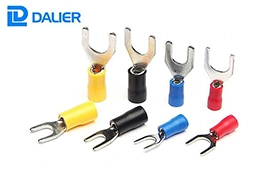
| Spade terminal | Quick‑connect fuse blocks, push‑on fuse holders | Applications requiring occasional disconnect |
| Female disconnect | Tab‑type fuse holders, relay sockets | 10A circuits, quick‑connect applications |
Which terminal goes where
Each terminal type serves a specific function in fuse circuits. The choice depends on the fuse holder's design and the installation's requirements.
For blade holders — blade terminals
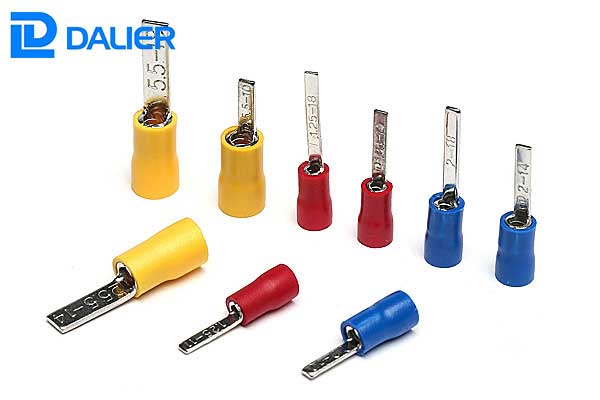
Blade terminals are designed for blade fuse holders — common in automotive and industrial fuse blocks. They slide directly into the fuse holder's female terminal, creating a secure connection that's easy to install. Vinyl‑insulated blade terminals are engineered for cable sizes between 0.5‑1.5mm² (22‑16 AWG) and handle currents up to 10‑19A.
For stud-mount holders — ring terminals
Ring terminals are used with stud‑mount fuse holders and bolt‑down connections. The ring completely encircles the stud, ensuring the connection stays secure even under vibration. Vinyl‑insulated ring terminals handle cables from 0.5‑1.5mm² with current ratings up to 19A.
For quick-connect blocks — spade and disconnect
Spade terminals and quick‑disconnect terminals are used with tab‑type fuse holders and relay sockets. They slide onto the fuse holder's male tab, creating a connection that can be easily disconnected for maintenance. Vinyl‑insulated spade and disconnect terminals are engineered for 0.5‑1.5mm² cables at 10A ratings.
What's inside the insulation
Dalier's vinyl‑insulated terminals are built with features that ensure reliable connections in fuse circuits.
Brass core, tin shield
High‑purity brass contacts with tin plating provide low contact resistance and superior corrosion protection. Tin plating prevents oxidation that can increase resistance and generate heat. For fuse circuits, that's essential — any added resistance affects the fuse's performance.
Color tells you the size
Vinyl insulation is color‑coded for easy identification — red for 22‑16 AWG, blue for 16‑14 AWG, yellow for 12‑10 AWG. Color coding reduces installation errors and speeds up maintenance. For panel builders, that means fewer mistakes and faster wiring.
Fire-safe by design
The insulation is made of tough, flame‑retardant thermoplastic (nylon 66, 94V‑2), providing good protection against fire hazards. In the event of an overload or fault, the insulation won't contribute to the fire risk — a critical safety feature in fuse circuits.
Four questions from the field
Q: Any terminal? Not for this job
A: No — the terminal must match the fuse holder's connection type. Blade terminals fit blade fuse holders, ring terminals fit stud‑mount holders, and spade/disconnect terminals fit quick‑connect fuse blocks. Using the wrong terminal creates a loose or high‑resistance connection that can cause overheating.
Q: What amp rating does the terminal need?
A: The terminal's current rating must match or exceed the fuse rating. Dalier's terminals for 0.5‑1.5mm² cables are rated at 10A‑19A. If your circuit uses a higher‑rated fuse, select a terminal that supports that current.
Q: Wire gauge — get it wrong and the terminal won't grip
A: The terminal must match the wire gauge. Using a terminal designed for 22‑16 AWG on a 12 AWG wire won't crimp properly. Using a 12‑10 AWG terminal on a 16 AWG wire won't grip securely. Color‑coding helps — red for 22‑16 AWG, blue for 16‑14 AWG, yellow for 12‑10 AWG.
Q: Blade vs. spade — what's the difference in practice?
A: Blade terminals are flat, rectangular connectors that slide into a female terminal. Spade terminals are fork‑shaped connectors that slide onto a male tab. Both are quick‑connect types, but blade terminals are more common in automotive fuse blocks, while spade terminals are often used in relay sockets and terminal blocks.
How Dalier supports reliable fuse circuit connections
Dalier Electrical manufactures vinyl‑insulated terminals for industrial and commercial applications. The company's terminals are engineered from high‑purity brass with tin plating, color‑coded vinyl insulation, and flame‑retardant materials. They're available in a range of types — blade, ring, spade, butt, and disconnect — to match different fuse holder configurations.
Before you install a terminal in a fuse circuit, check the fuse holder type, the wire gauge, and the current rating. The right terminal ensures a secure, low‑resistance connection that lets the fuse do its job — protect your equipment and your people.
Ready to select the right vinyl‑insulated terminals for your fuse circuits? Contact Dalier Electrical for samples or a quote. Share your fuse holder type, wire gauge, and current requirements — their team can recommend the right terminals for your application.