English
 中文
 Русский язык
 Français
 Español


How Does a Thermal Relay Gain More Contacts?
You've specified a Thermal Relay for motor overload protection, and the main contact is already wired into the contactor coil circuit. But now the panel drawing calls for a signal to the PLC, a pilot light on the door, and an alarm horn in the corridor. The relay's built-in contact can't carry all three. The F4-SK4 auxiliary contact group snaps onto the top of the JZC4 contactor-type relay and adds up to four independent signaling contacts, with a sliding self-cleaning action that keeps the circuit reliable through repeated operations. This article explains how the auxiliary block expands the control circuit, what the SK4 air-delay option contributes, and what to verify when you're matching an auxiliary group to your panel design.
How Does the Auxiliary Block Mount and Connect?
Top-Mount Fixing on JZC4 Relays
The F4-SK4 is designed to mount on top of the JZC4 series contactor-type relay, which is the relay that sits on a CJX2 series AC contactor. The block aligns with the relay's auxiliary contact terminals and locks into position without additional brackets or DIN rail. That top-mount arrangement keeps the assembly compact—the auxiliary contacts sit directly above the relay body rather than beside it, so the panel footprint doesn't grow.
The connection is mechanical and electrical at the same time. The block's pins engage the relay's terminals, and the locking clip holds the assembly together under vibration. There's no separate wiring between the relay and the block, which eliminates the loose-wire failure mode that plagues add-on contact blocks.
Contact Configurations From 1NO/1NC to 4NO
The F4 series covers eight contact configurations, from F4-11 (1 normally open, 1 normally closed) up to F4-40 (4 normally open). The intermediate models include F4-20 (2NO), F4-02 (2NC), F4-31 (3NO+1NC), F4-13 (1NO+3NC), and F4-22 (2NO+2NC).
That range matters because different panels need different signal logic. A PLC input typically needs a normally open contact that closes on fault. A pilot light might need a normally closed contact that opens on fault. A multi-function panel might need both, plus a spare. The F4-22 is the most common general-purpose choice because it provides two of each in a single block.
| Model | NO Contacts | NC Contacts | Typical Use |
|---|---|---|---|
| F4-11 | 1 | 1 | Basic fault signal + pilot light |
| F4-20 | 2 | 0 | Dual PLC inputs on fault |
| F4-02 | 0 | 2 | Dual NC interlocks |
| F4-22 | 2 | 2 | General-purpose panel signaling |
| F4-31 | 3 | 1 | Multi-point alarm with one NC |
| F4-13 | 1 | 3 | Multiple NC safety interlocks |
| F4-40 | 4 | 0 | Four independent NO signals |
What Does the Sliding Contact Action Contribute?
Self-Cleaning and Reliable Making
The auxiliary group uses a sliding contact function. When the relay operates, the moving contact wipes across the fixed contact rather than closing on a single point. That wiping action breaks through any oxide film or dust layer that has formed on the contact surface, so the circuit makes reliably even after long idle periods.
In an industrial panel, contacts sit idle for weeks and then operate during a fault. The oxide layer that builds up during the idle period can prevent a dry circuit from making at all. The sliding action removes that layer at the moment of closure, which is why the F4-SK4 is described as self-cleaning. The 10A rated current provides enough capacity for pilot lights, PLC inputs, and small contactor coils without requiring an interposing relay.
Electrical Ratings Under AC-15 and DC-13
The F4-22 auxiliary contact group is rated for AC-15 at 380V AC, 0.95A, and DC-13 at 220V DC, 1.5A. Those utilization categories cover the typical signaling loads in a motor control panel: AC contactor coils and pilot lights on the AC side, and DC relays and PLC inputs on the DC side.
The 10A conventional thermal current is the continuous current the contact can carry without excessive heating. The AC-15 and DC-13 ratings are lower because they account for the making and breaking of inductive loads, where the arc energy is higher than a resistive load. Matching the auxiliary contact's rating to the actual load ensures the contact doesn't weld or erode prematurely.
What Does the SK4 Air-Delay Option Add?
On-Delay and Off-Delay Ranges
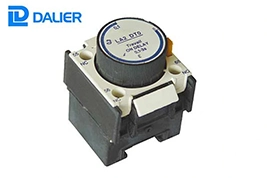
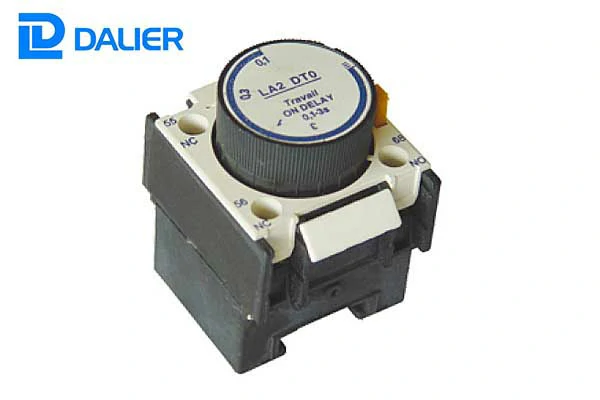
The SK4 air-delay module fits into the same F4-SK4 assembly and adds a time-delay function to the auxiliary contact. The SK4-2x series provides energizing time-delay (on-delay), and the SK4-3x series provides breaking time-delay (off-delay). The delay ranges are 0.1–3s, 0.1–30s, and 10–180s, depending on the model.
An on-delay auxiliary contact is useful for sequencing: the relay picks up on fault, but the alarm signal is delayed by a few seconds to ride through a momentary overload that clears on its own. An off-delay contact is useful for cooling: the relay drops out, but the cooling fan keeps running for a set period after the motor stops.
Delay Settings and Panel Coordination
The air-delay setting is adjustable on the module. The operator sets the delay to match the process requirement—short delays for ride-through, longer delays for cooling or sequential shutdown. The delay is independent of the main relay's trip time, so the protection function remains immediate while the signaling function is delayed.
That separation matters in a coordinated panel. The thermal relay trips on overload as fast as its inverse-time curve allows, but the PLC signal can be delayed to prevent nuisance alarms from transient overloads. The F4-SK4 with the SK4 module provides both functions in one assembly.
Where Does the Auxiliary Group Fit in Motor Control Panels?
A Thermal Relay with an F4-SK4 auxiliary group is the standard configuration for motor control centers where the overload relay has to do more than interrupt the contactor coil. The auxiliary contacts carry the fault signal to the PLC, the indicator lamps on the panel door, the alarm horn, and the upstream monitoring system.
The top-mount design keeps the assembly compact, which matters in high-density motor control centers where panel space is at a premium. The sliding self-cleaning action reduces the risk of a missed signal after a long idle period. The SK4 delay option adds sequencing capability without requiring a separate timer relay and its associated wiring.
What Should You Check Before Selecting an Auxiliary Group?
How do I choose the contact configuration?
Count the signals the panel needs. One normally open contact for the PLC, one normally closed for a pilot light, and one spare normally open for a future modification adds up to 2NO+2NC, which is the F4-22. If the panel has multiple PLC inputs on the same fault, the F4-40 provides four normally open contacts. Match the configuration to the signal count, and leave at least one spare contact for field changes.
Do I need the SK4 air-delay module?
Add the SK4 module if the panel requires a delayed alarm, a delayed cooling fan run-on, or a sequencing signal. The 0.1–30s range covers most ride-through and short-delay applications. The 10–180s range suits cooling run-on and longer sequencing delays. If the panel doesn't need a delay, the standard F4 auxiliary group without the SK4 module is sufficient.
What are the mounting and clearance requirements?
The block mounts on top of the JZC4 relay, so the panel layout has to leave clearance above the relay for the auxiliary block and its wiring. The F4-11 measures 48mm (H) × 27mm (W) × 39mm (D), and the F4-22 measures 48mm (H) × 45mm (W) × 39mm (D). Confirm that the enclosure depth and the wire duct routing leave enough room for the block and the terminal screws.
What maintenance does the sliding contact need?
The sliding contact is self-cleaning during operation, so routine maintenance is minimal. Inspect the contact surfaces during scheduled panel maintenance for signs of heavy erosion or discoloration. Verify that the locking clip is secure and the block is fully seated on the relay. Check the terminal screws for tightness, especially after a fault event that may have caused vibration.
Straight Answers on Auxiliary Contact Groups
Can the F4-SK4 be used on other relay brands?
The F4-SK4 is designed specifically for the JZC4 series contactor-type relay on the CJX2 series AC contactor. The mounting geometry and terminal alignment are matched to that relay family. It's not a universal add-on block, and it shouldn't be forced onto a different relay footprint.
What's the difference between the F4 and F4-SK4?
The F4 designation covers the auxiliary contact group itself—the block with the sliding contacts. The SK4 designation refers to the air-delay module that fits into the assembly. An F4-SK4 group includes the delay function, while a standard F4 group without the SK4 module provides auxiliary contacts without the time delay.
What does "self-cleaning" actually mean?
Self-cleaning means the sliding action of the contact wipes the contact surfaces during each operation, removing oxide films and light contamination. It's a mechanical cleaning action, not a chemical one. The result is a more reliable make after long idle periods, which is the condition where oxide buildup is most likely to cause a signal failure.
What standards does the auxiliary group meet?
The F4 series auxiliary contact group is manufactured to GB/T14048.5 and IEC60947-5-1 standards, with CCC certification and CE marking. Those standards cover the performance and safety requirements for auxiliary contact blocks in industrial control circuits.
Let's Match an Auxiliary Group to Your Panel Design
Share Your Signal Count and Delay Requirement
A Thermal Relay with the F4-SK4 auxiliary contact group should match your signal count, delay requirement, and panel layout—not the other way around. The F4-SK4 from Dalier provides up to 4 auxiliary contacts in configurations from 1NO/1NC to 4NO, with sliding self-cleaning contacts rated 10A and AC-15/DC-13 signaling capacity. The optional SK4 air-delay module adds 0.1–180s on-delay or off-delay sequencing. If you're laying out a motor control panel with PLC signaling, pilot lights, or alarm circuits, send us your signal count and delay requirement — we'll help you confirm the right F4 configuration and SK4 delay range before you order.