English
 中文
中文 Русский язык
 Français
 Español

Does a Non-Insulated Spade Terminal Need Tin Plating?
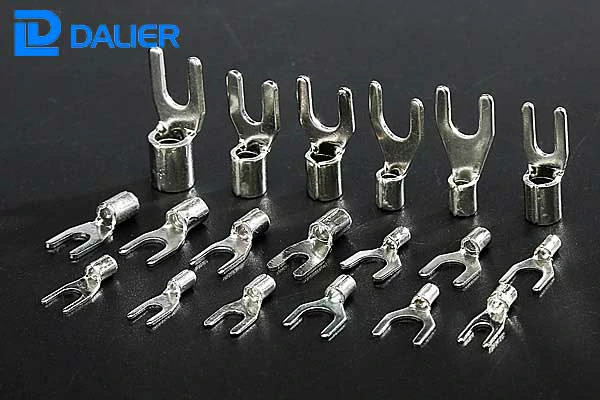
You're specifying terminals for an industrial control panel or an automotive harness, and the choice comes down to a simple question: bare copper or tin-plated? A Non-Insulated Terminals solution with tin plating resists oxidation, extends service life, and maintains stable conductivity in humid or corrosive environments. The SNB series from Dalier uses oxygen-free copper as the base material with a tin-plated finish to deliver exactly this performance. This article explains what tin plating contributes to terminal reliability, how the SNB series is configured across different wire sizes, and what to verify before specifying a crimp terminal for your application.
What Does Tin Plating Actually Deliver?
Tin plating is a thin layer of tin applied over the copper base. Its primary function is corrosion resistance. Copper oxidizes readily when exposed to air and moisture, forming a non-conductive oxide layer that increases contact resistance. Tin oxidizes much more slowly and its oxide remains conductive. The result is a terminal that maintains low resistance over years of service, even in humid or chemically exposed environments. The SNB series uses high-quality oxygen-free copper with tin plating to resist corrosion, stress, and tension.
Oxidation Resistance for Long-Term Connections
The tin layer prevents the copper beneath from oxidizing. Without it, the terminal surface would gradually develop a resistive oxide film, causing voltage drop and heating at the connection point. Tin plating ensures that the contact interface stays clean and conductive.
Solderability and Crimp Performance
Tin plating also improves solderability for applications that require soldering. For crimped connections, the tin layer deforms with the copper during crimping, creating a gas-tight joint that resists moisture ingress.
How Is the SNB Series Configured Across Wire Sizes?
The SNB series covers wire sizes from 0.5mm² to 6mm² (AWG 22-10), with current ratings from 19A to 48A. Each wire size range has its own set of stud hole options, from #4 (3.2mm) through 1/4" (6.4mm). The terminal thickness increases with wire size, from 0.7mm on the 1.25 series to 1.0mm on the 5.5 series.
| Cable Size | AWG | Max Current | Material | Thickness |
|---|---|---|---|---|
| 0.5-1.5mm² | 22-16 | 19A | Purple copper | 0.7mm |
| 1.5-2.5mm² | 16-14 | 27A | Purple copper | 0.8mm |
| 2.5-4mm² | 14-12 | 37A | Purple copper | 1.0mm |
| 4-6mm² | 12-10 | 48A | Purple copper | 1.0mm |
Stud Hole Options for Different Bolt Sizes
The SNB series is available with stud holes from #4 through 1/4", covering the bolt sizes used in control panels, terminal blocks, and battery connections. The fork shape allows the terminal to slide onto a loosened stud and be secured with a partial turn.
Material Thickness for Current Capacity
The terminal thickness increases with the current rating. The 1.25 series uses 0.7mm copper, while the 5.5 series uses 1.0mm. Thicker material handles higher current without overheating and provides the mechanical strength needed for larger wire crimps.
What Makes the SNB Series Suitable for Industrial Use?
The SNB series is designed for direct crimp connections where insulation is not required or where the connection point is protected within an enclosure. The bare design allows direct metal-to-metal contact for maximum conductivity and heat dissipation. The terminals are easily connected to a wire via a standard crimper.
Direct Metal-to-Metal Contact
Without insulation, the terminal makes direct contact with the stud or terminal block. This provides the lowest possible resistance and allows heat to dissipate more efficiently than insulated alternatives.
Quick Connection and Disconnection
The spade or fork shape allows the terminal to be slipped onto a loosened stud without removing the nut completely. This makes it ideal for applications requiring frequent disconnection, such as maintenance access points or test connections.
Where Does a Bare Spade Terminal Deliver the Most Value?
The SNB series serves a wide range of applications, from industrial control panels to automotive wiring. The terminals are suitable for machinery, electrical equipment, transportation, and other systems requiring reliable crimped connections.
-
Industrial control panels — terminating wires on terminal blocks and stud connections
-
Automotive wiring — battery cables, ground connections, and accessory circuits
-
Machinery and equipment — motor leads, sensor wiring, and power distribution
-
Power distribution — connections in distribution boxes and junction points
-
Renewable energy — DC wiring in solar and energy storage systems
Industrial Control and Machinery Wiring
In control panels, the SNB terminal provides a reliable crimped connection between field wiring and terminal blocks. The tin plating resists the humidity and temperature variations found in industrial environments.
Automotive and Transportation Applications
Automotive wiring harnesses use bare spade terminals for battery connections, ground points, and accessory circuits. The oxygen-free copper and tin plating deliver the conductivity and corrosion resistance that these applications require.
Common Questions About Bare Crimp Terminals
What wire sizes does the SNB series cover?**
The SNB series covers 0.5mm² to 6mm² (AWG 22-10), with current ratings from 19A to 48A. Each wire size range has its own set of stud hole options.
What is the base material and surface treatment?**
The terminal is made from oxygen-free copper with a tin-plated finish. This combination provides high conductivity and corrosion resistance.
Can these terminals be used in high-vibration environments?**
Yes, when properly crimped with a standard crimping tool. The crimped connection is mechanically stable and resists vibration better than screw-terminal connections.
What certifications does the SNB series carry?**
The terminals carry RoHS, CE, and ISO9001 certification. The material and finish comply with environmental and quality standards for industrial and automotive applications.
Request a Non-Insulated Terminal Configuration
A Non-Insulated Terminals solution with oxygen-free copper, tin plating, and current ratings from 19A to 48A is the practical choice for industrial and automotive wiring where reliable crimped connections are required. The Non-insulated Spade terminal SNB from Dalier delivers 0.5-6mm² cable range, 19A-48A current ratings, purple copper construction with tin plating, and stud hole options from #4 to 1/4". Contact Dalier for a non-insulated terminal configuration assessment → their team can help you select the right wire size, stud hole, and quantity for your specific application.