English
 中文
中文 Русский язык
 Français
 Español

Can a Thermal Relay Protect DC Motors From Overload?
You're running a DC motor on an industrial line, and the load has been creeping up. The motor draws more current, the windings heat up, and if nothing intervenes, the insulation fails. A Thermal Relay built for DC systems watches that current and trips the circuit before the motor is damaged. It's not a complicated device, but it performs a function that fuses and breakers alone can't cover: sustained overload protection with a time delay that matches the motor's thermal characteristics. This article explains how DC thermal relays differ from AC types, what the JRS2-180/F series delivers, and what to verify before specifying one for your system.
How Does Overload Protection Differ in DC Circuits?
The principle behind thermal overload protection is the same in AC and DC: current flows through a heating element, a bimetallic strip bends, and a trip mechanism opens a contact. But DC systems present specific challenges. A DC motor's thermal behavior differs from an AC motor's, and the relay must be selected to match the motor's dynamic thermal characteristics, not just its rated current. The JRS2-180/F series is designed specifically for industrial DC systems, providing reliable overload protection and a polar anti-reverse connection function. That anti-reverse feature matters in DC circuits, where reversed polarity can cause immediate and severe damage to motors, controllers, and power supplies.
The Bimetallic Element and Time Delay
A thermal relay uses a bimetallic strip that bends as it heats. The amount of bend depends on the current and the time it flows. At normal operating current, the strip stays within its elastic range. During an overload, the strip bends further and eventually trips the contact. The time delay is intentional: it allows short-duration inrush currents, like motor starting, without tripping, while still protecting against sustained overloads that would eventually cause damage.
Why Anti-Reverse Protection Matters in DC
In a DC circuit, polarity is fixed. If a conductor is reversed—whether by incorrect wiring or a fault—current flows in the wrong direction, and the motor may run backward or the controller may fail. The JRS2-180/F series includes a polar anti-reverse function, which prevents operation when the polarity is incorrect.
What Features Distinguish the JRS2-180/F Series?
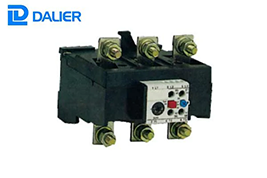
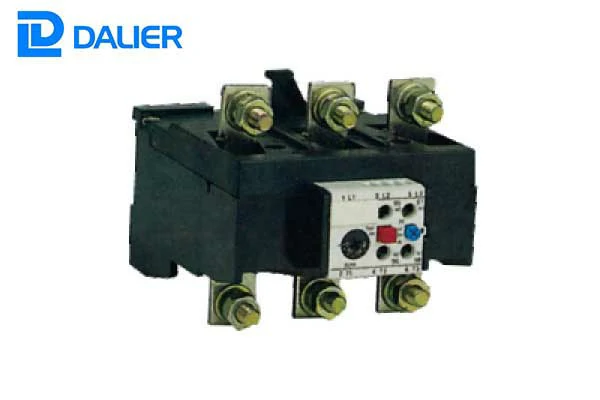
The JRS2-180/F series is a separated-type thermal relay designed for DC industrial applications. It supports manual reset, allowing the operator to restore the circuit after a trip once the fault is cleared. A built-in temperature compensation module adjusts the trip point based on ambient temperature, preventing nuisance trips in hot or cold environments. The relay conforms to GB 14048.4, IEC 60947-4, and VDE 0660 standards. The JRS2 series as a whole covers rated currents from 0.1A to 630A, with the JRS2-180 model accommodating setting ranges that include 55-80A, 63-90A, 80-110A, 90-120A, 110-135A, 120-150A, 135-160A, and 150-180A. This range covers the majority of industrial DC motor protection requirements.
Manual Reset for Controlled Restart
After a trip, the JRS2-180/F requires a manual reset. This gives the operator time to identify and correct the overload condition before restarting the motor. Automatic reset, while convenient, can lead to repeated cycling if the fault is not addressed.
Temperature Compensation for Stable Operation
The built-in temperature compensation module adjusts the trip threshold based on ambient conditions. In a cold plant, the relay would otherwise trip at a lower current than specified; in a hot plant, it might not trip soon enough. Compensation keeps the protection consistent.
Technical Specifications for DC Protection
| Parameter | Specification |
|---|---|
| Model | JRS2-180/F series |
| Application | Industrial DC systems |
| Functions | Overload protection, polar anti-reverse connection |
| Reset Mode | Manual |
| Temperature Compensation | Built-in module |
| Standards | GB 14048.4, IEC 60947-4, VDE 0660 |
| Setting Ranges | 55-80A, 63-90A, 80-110A, 90-120A, 110-135A, 120-150A, 135-160A, 150-180A |
| Suitable Contactor | CJX1-85, 110, 140, 170, 205 |
Setting Range Selection
The setting range must bracket the motor's full-load current. If the motor's rated current is 75A, the 63-90A range is appropriate. The adjustment dial allows fine-tuning within the range to match the exact operating current.
Contactor Compatibility
The JRS2-180/F series can be mounted together with CJX1 series contactors for combination installation, or fixed independently. The suitable contactor models are CJX1-85 through CJX1-205.
Where Does a DC Thermal Relay Fit in Industrial Systems?
The JRS2-180/F series serves industrial DC systems where motors, power supplies, or distribution circuits require overload protection. DC drives for conveyors, pumps, and process equipment are common applications. Battery charging systems, electroplating rectifiers, and DC distribution panels also benefit from dedicated DC protection. The polar anti-reverse function is particularly valuable in systems where connectors or terminals could be reversed during maintenance.
-
DC motor drives — conveyors, pumps, and process equipment
-
Battery charging systems — protecting charging circuits from overload
-
Electroplating and electrolysis — DC power supplies for industrial processes
-
DC distribution panels — branch circuit protection
-
Industrial equipment — any DC circuit requiring sustained overload protection
DC Motor Drives and Conveyors
In a conveyor drive, a jam or mechanical overload causes the DC motor to draw higher current. The thermal relay trips after the overload persists, preventing winding damage. The time delay allows the motor to start without tripping on inrush current.
Battery Charging and DC Power Supplies
Charging circuits can experience overload if a battery is deeply discharged or a fault develops. The thermal relay provides backup protection, while the anti-reverse function prevents damage from incorrect polarity.
Common Questions About DC Thermal Relays
Can an AC thermal relay be used in a DC circuit?
It can be used if the protection coordination is correct, but the DC motor's thermal characteristics differ from an AC motor's. A relay designed for DC systems, like the JRS2-180/F series, provides more accurate protection and includes polarity protection that standard AC relays lack.
What is the difference between thermal overload and short-circuit protection?
A thermal relay protects against sustained overcurrent caused by overload. It does not replace short-circuit protection. Fuses or circuit breakers are still required to handle high-magnitude fault currents.
How do I select the correct setting range?
Start with the motor's rated full-load current. Choose the setting range that brackets that value. For example, a motor with 85A full-load current uses the 63-90A or 80-110A range, depending on the exact current and the desired adjustment margin.
What maintenance does the relay require?
Thermal relays have no routine maintenance requirements beyond periodic inspection of connections and verification that the reset mechanism operates freely. If the relay trips frequently without an obvious overload, check the setting range and ambient temperature compensation.
Request a DC Thermal Relay Configuration for Your System
A Thermal Relay designed for DC systems provides overload protection that matches the motor's thermal behavior, with the added safety of polar anti-reverse connection. The JRS2-180/F series from Dalier delivers manual reset, built-in temperature compensation, setting ranges from 55A to 180A, and compliance with GB 14048.4, IEC 60947-4, and VDE 0660.
Contact Dalier for a DC thermal relay configuration assessment → their team can help you select the right setting range and contactor combination for your specific DC motor and application.