English
 中文
 Русский язык
 Français
 Español


Why Does a Ring Shape Make Non-Insulated Terminals Stable?
Non-Insulated Terminals earn their place in a wiring harness by doing one thing well: they grip the conductor with a direct crimp and they present a stable contact surface to the stud. The RNB ring design takes that further by closing a full circle around the bolt. You'll see why that geometry resists vibration, what the copper and tin layers contribute, and where the 0.5–1.5mm² / 19A version fits.
What Questions Come Up Before Choosing a Ring Lug?
Why does a ring outperform a spade or blade under vibration?
A spade or blade terminal makes contact on one or two faces of the male tab. Under vibration, that contact can fret or loosen because the mating surfaces can move relative to each other. A ring terminal encircles the stud or bolt, so the clamping force is distributed around the full circumference. The page describes the RNB ring shape as providing the most stable bolt connection possible and being ideal where vibration resistance is critical. The bolt can't back out of a closed ring the way a spade can slip off a tab.
What does “non-insulated” change about the installation?
A non-insulated terminal has no vinyl or nylon sleeve over the barrel. That means the crimp barrel is fully visible, so the installer can inspect the crimp compression directly. It also means the terminal is shorter and narrower at the barrel than an insulated version, which matters in tight terminal blocks or crowded panel layouts. The page lists direct crimping as the design intent of the RNB. The trade-off is that the crimp and the exposed barrel need to be rated for the installation's voltage clearance, which is a specification decision rather than a terminal limitation.
The Copper and Tin Layer
The conductor is high-purity oxygen-free copper, and the surface is tin-plated for corrosion resistance. That combination is deliberate. Oxygen-free copper avoids the oxides that can form inside a standard copper billet during melting, which keeps the conductivity consistent across the part. Tin plating sits on the outside, where it protects the copper from the environment and provides a stable contact surface against the mating stud.
The page lists the material as purple copper at 0.7mm thickness for the 0.5–1.5mm² range. The 0.7mm wall is the balance between crimp deformation and mechanical strength: thick enough to hold the crimped conductor without cracking, thin enough to deform around the wire strands when the tool closes.
| Parameter | RNB (0.5–1.5mm² range, from the product page) |
|---|---|
| Cable size | 0.5–1.5mm² (AWG 22-16) |
| Max current | Imax = 19A |
| Material | Purple copper (oxygen-free) |
| Plating | Tin |
| Thickness | 0.7mm |
| Design | Non-insulated, ring shape for bolt connection |
| Applications | Industrial control, automotive battery, power distribution, solar panel wiring |
Why tin plating matters beyond corrosion
Tin is softer than copper, so it deforms slightly under the clamping force of the bolt. That deformation fills microscopic gaps between the ring and the stud, which lowers contact resistance at the joint. A bare copper ring would oxidize over time and raise that resistance; the tin layer keeps the interface stable.
Crimping, Inspection, and the Barrel
A non-insulated terminal is only as good as its crimp. The page specifies a cable range of 0.5–1.5mm² for the base RNB model, with the barrel sized to accept that conductor class. The crimp tool has to match the barrel and the wire gauge—a tool that's too large won't compress the barrel onto the strands, and a tool that's too small will over-compress and crack the copper.
The non-insulated format makes that inspection straightforward. The installer can see the crimp indentation on the barrel and confirm that the wire strands are captured inside. On an insulated terminal, that visual check is blocked by the sleeve. For a production line or a panel shop where every connection is inspected, the visible crimp is a quality-control advantage.
-
Cable range: 0.5–1.5mm² (AWG 22-16) on the base model
-
Crimp inspection: barrel is open to visual check after crimping
-
Barrel length: sized to the conductor class, not a universal length
-
Tool match: crimper must match the barrel and wire gauge
-
Stud sizes: multiple ring openings from #4 through 1/2 in the same range
What the ring opening sizes cover
The page lists ring openings from #4 (3.2mm) through 1/2 (13.0mm) within the same 0.5–1.5mm² cable range. That spread means the same wire can be terminated onto a small control-panel stud or a larger battery post without changing the wire gauge. The part number changes with the stud size, not the conductor.
Where the 19A Version Fits the Circuit
The 0.5–1.5mm² RNB is rated Imax=19A. That current level covers control wiring, small battery connections, signal circuits, and low-power distribution. The page lists the application areas as industrial control, automotive battery, power distribution, and solar panel wiring.
In a solar panel wiring application, the ring terminal lands on a junction box stud or a combiner terminal. The tin plating resists the outdoor humidity, and the ring shape holds the connection against wind-driven vibration on a roof or a ground mount. In an automotive battery application, the ring goes over the battery post bolt, where engine vibration would work a spade terminal loose.
When to step up to a larger cable size
The RNB series extends beyond the 0.5–1.5mm² base model. The same ring design is available in larger cable sizes for higher-current circuits, following the same non-insulated copper construction. The 19A version is the entry point; the circuit's continuous current and the conductor size determine which model in the range is the right fit.
Where CNDALIER Fits the Terminal Supply
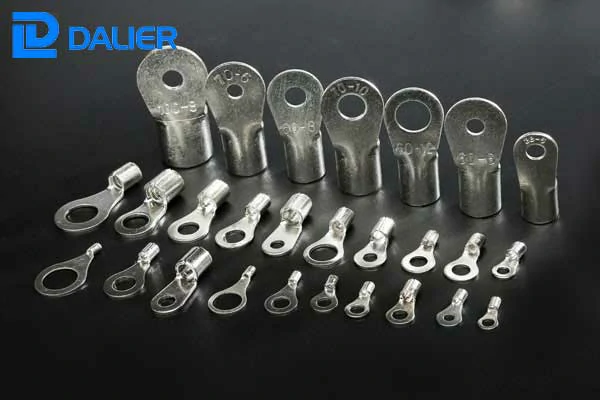
The RNB Non-Insulated Terminals from CNDALIER (Dalier) are built around the ring-and-copper construction described on the page: high-purity oxygen-free copper, tin plating, a 0.7mm wall on the 0.5–1.5mm² model, and ring openings from #4 through 1/2 within that cable range. The non-insulated barrel allows direct crimping and visual inspection, and the ring geometry provides the vibration-resistant connection the page highlights for automotive, industrial machinery, and electrical panel applications. For a panel builder or a harness shop, the value sits in the simple geometry—a closed ring on a stud, a copper conductor with a tin surface, and a crimp that can be checked by eye.
What to confirm before matching a terminal to a circuit
Confirm the cable size against the terminal's range, the stud size against the ring opening, and the continuous current against the Imax rating. Check the plating against the environment—tin suits humid and outdoor conditions, but a more aggressive atmosphere may call for a different surface. The page's dimension table gives the starting point; the wire gauge and the stud determine the part number.
Let's Match an RNB Terminal to Your Stud and Wire
Send over your wire gauge, stud size, and continuous current—we'll help you check them against the 0.5–1.5mm² / Imax=19A RNB model and the ring openings from #4 through 1/2. Talk to CNDALIER about your Non-Insulated Terminals requirements and get a part-number-level answer before you commit to the order.