English
 中文
中文 Русский язык
 Français
 Español

Are Vinyl-Insulated Terminals Designed for Quick Disconnect?
You're terminating wires in a control panel or equipment harness. The connection may need to be removed for testing, maintenance, or replacement. A Vinyl-Insulated Terminals solution with a spade fork design provides quick-disconnect capability. The funnel-entry and color-coding features make installation faster and more reliable. This article explains how the quick-disconnect design works, what the color codes mean, and what to verify before specifying spade terminals for your assembly.
What Makes a Spade Terminal a Quick-Disconnect Solution?
A spade terminal has a fork-shaped end that slides onto a stud or screw. Unlike a ring terminal, which requires the nut to be completely removed before installation, a spade terminal can be slipped onto a loosened stud and secured with a partial turn. This makes it the preferred choice for connections that need periodic removal — test points, field-replaceable components, and circuits that require maintenance access. The trade-off is that spade terminals can loosen under vibration, so they are not recommended for permanent, high-vibration applications.
The Fork Design and Stud Compatibility
The spade's fork shape is designed to fit around a stud of a specific diameter. The terminal must match the stud size, not just the wire gauge. A spade terminal with a 4.3mm opening fits a #8 stud; a 6.4mm opening fits a 1/4" stud. Using the wrong size results in a loose connection or a terminal that won't fit at all.
When to Choose Spade Over Ring for Serviceability
Use a spade terminal when the connection will be removed for testing, maintenance, or replacement. The slip-on design saves time during service. Use a ring terminal when the connection is permanent and vibration is a concern. Ring terminals distribute the clamping force around the full circumference of the stud, providing a more secure hold.
How Does Color Coding Prevent Wiring Errors?
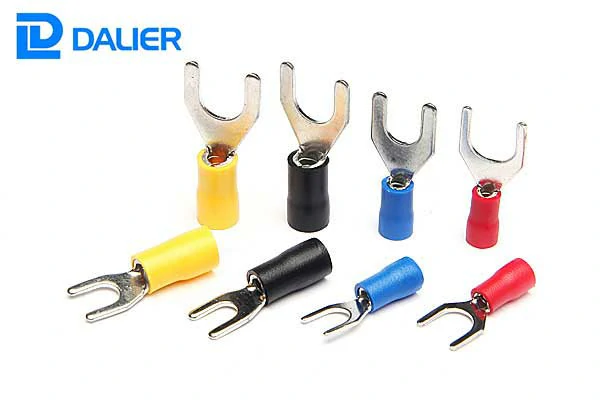
The vinyl insulation on the spade terminal is color-coded to indicate the wire gauge. This color coding provides a quick visual reference for the wire size, reducing the chance of mismatching terminals and wires during assembly. The red insulation indicates the SV1.25 series for 0.5-1.5mm² wire. The blue insulation indicates the SV2 series for 1.5-2.5mm² wire. The black insulation indicates the SV3.5 series for 2.5-4mm² wire. The yellow insulation indicates the SV5.5 series for 4-6mm² wire.
Matching Insulation Color to Wire Gauge
Each color corresponds to a specific wire size range and current rating. The red series is rated for 19A, the blue series for 27A, the black series for 37A, and the yellow series for 48A. The color coding makes it easy for operators to select the correct terminal without measuring or referencing a chart.
Reducing Assembly Time and Rework
Color coding reduces the time spent searching for the right terminal and minimizes the risk of installing the wrong size. In high-volume assembly, these small time savings add up. The visual reference also makes it easier to spot errors during inspection, reducing rework and improving overall quality.
Why Does Funnel Entry Matter in High-Volume Crimping?
The funnel entry is a flared section of the PVC insulation that guides the wire into the terminal's crimp barrel. Without it, the operator must carefully align the wire strands with the barrel opening — a task that slows down high-volume production and increases the risk of stray strands. With the funnel entry, the wire slides in with minimal effort.
The Flared PVC Sheath and Wire Guidance
The flared sheath creates a funnel that accepts the wire even if it's slightly off-angle. The PVC material is flexible enough to guide the wire but rigid enough to maintain its shape during insertion. This combination of flexibility and rigidity is what makes the funnel entry effective in production environments where speed and consistency matter.
Avoiding Partial Insertion and Hot Spots
A proper crimp requires the wire strands to be fully inserted into the barrel before the crimping tool is applied. If the wire stops short, the crimp captures only part of the conductor, reducing current-carrying capacity and creating a hot spot. The funnel entry helps ensure full insertion by removing the alignment barrier that causes short insertion.
What Electrical Ratings Apply to Different Terminal Sizes?
| Parameter | SV1.25 Series | SV2 Series | SV3.5 Series | SV5.5 Series |
|---|---|---|---|---|
| Cable Size | 0.5-1.5mm² (AWG 22-16) | 1.5-2.5mm² (AWG 16-14) | 2.5-4mm² (AWG 14-12) | 4-6mm² (AWG 12-10) |
| Max Current | 19A | 27A | 37A | 48A |
| Material | Purple copper | Purple copper | Purple copper | Purple copper |
| Thickness | 0.7mm | 0.8mm | 1.0mm | 1.0mm |
| Insulation Color | Red | Blue | Black | Yellow |
| Stud Sizes | #4 to 1/4" | #4 to 5/16" | #4 to 1/4" | #6 to 5/16" |
Current Capacity from 19A to 48A
Each terminal size has a specific current rating. The SV1.25 series handles 19A, the SV2 series handles 27A, the SV3.5 series handles 37A, and the SV5.5 series handles 48A. These ratings cover most control, signal, and power circuits in industrial and commercial equipment.
Material and Thickness Specifications
The conductive body is made from purple copper, which provides high conductivity and corrosion resistance. The material thickness increases with the terminal size, from 0.7mm on the SV1.25 series to 1.0mm on the SV3.5 and SV5.5 series. This ensures that the larger terminals can handle the mechanical forces of crimping and the higher currents they carry.
Where Are Quick-Disconnect Terminals Most Effective?
Spade terminals are used in any application where a wire needs to connect to a screw terminal and may need to be disconnected later. Control panels, equipment harnesses, test benches, and field-replaceable components all benefit from the slip-on design.
Control Panels and Signal Circuits
Control panels use spade terminals for sensor connections, relay coils, and low-power signal circuits. The 19A rating of the red series is more than adequate for these applications, and the funnel entry speeds up panel assembly.
Test Points and Field-Serviceable Connections
Test points and field-serviceable connections are the classic spade terminal application. The slip-on design allows a technician to remove and replace a wire without disassembling the terminal stack. This saves time during commissioning and maintenance.
Equipment Harnesses and Appliance Wiring
Equipment harnesses and appliance wiring use spade terminals where the connection may need to be broken for repair or replacement. The vinyl insulation provides electrical protection and a clean appearance.
Answers to Common Questions About Quick-Disconnect Terminals
What is the difference between a spade terminal and a ring terminal?
A spade terminal has a fork-shaped end that slides onto a loosened stud. A ring terminal has a closed circular end that requires the nut to be fully removed. Spade terminals are faster to install and remove, while ring terminals provide a more secure connection under vibration.
How do I choose the right terminal size?
Match the terminal to the wire gauge and the stud size. The wire gauge determines the series (SV1.25 for 0.5-1.5mm², SV5.5 for 4-6mm²). The stud size determines the fork opening (4.3mm for #8, 6.4mm for 1/4"). Both must match for a proper connection.
What is the maximum current for the 0.5-1.5mm² terminal?
The SV1.25 series is rated for 19A maximum current. This covers most control, signal, and low-power circuits. For higher currents, the SV2 series handles 27A, the SV3.5 series handles 37A, and the SV5.5 series handles 48A.
What maintenance do spade terminals require?
Spade terminals should be checked periodically for tightness. Under vibration, the fork can loosen on the stud. A quick torque check during scheduled maintenance ensures the connection remains secure. If the terminal shows signs of overheating or corrosion, it should be replaced.
Get a Quick-Disconnect Terminal Configuration for Your Assembly
A Vinyl-Insulated Terminals solution with a spade fork design, color-coded insulation, and funnel entry is the practical choice for wire connections that need speed and serviceability. The spade terminal from Dalier delivers 0.5-1.5mm² cable compatibility, 19A max current, purple copper construction with 0.7mm thickness, a flared PVC sheath for easy wire insertion, and color-coded insulation for quick identification.
Whether you're assembling control panels, equipment harnesses, or test benches, this terminal offers the installation speed and connection reliability that production environments demand. With four size series covering 0.5mm² to 6mm², it adapts to your specific wire gauge requirements.
Contact Dalier for a spade terminal configuration assessment → their team can help you select the right series, stud size, and insulation color for your specific wire gauges and connection points. Get a Vinyl-Insulated Terminals solution that slides on fast — so your assembly line keeps moving.