English
 中文
 Русский язык
 Français
 Español


Why Do Non-Insulated Terminals Use Copper Tubes?
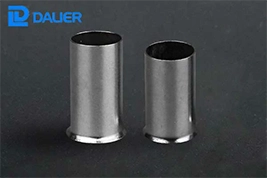
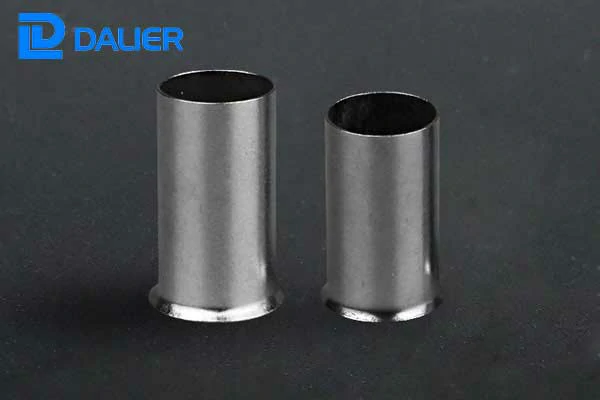
You're landing a stranded wire into a screw clamp terminal block, and the strands splay out under the screw—some clamped, some loose. A Non-Insulated Terminals ferrule solves that problem by compressing the stranded conductor into a solid, square pin before it meets the terminal. The EN series from Dalier uses a high-conductivity copper tube with a corrosion-resistant surface treatment, available from 0.5mm² through 50mm². This article explains why the copper tube construction matters, what the DIN 46228 dimensions mean, and what to verify when you're matching a cord end to your wire and terminal block.
Why Does a Ferrule Improve Stranded Wire Termination?
Containing the Strands Before the Clamp
A stranded conductor is a bundle of fine wires. When you insert it directly into a screw clamp, the screw compresses the bundle unevenly—some strands take the load, others sit loose. Over time, loose strands can vibrate free, reduce contact area, and cause localized heating.
A cord end ferrule slides over the stripped conductor and is crimped. The crimp compresses the copper tube and the strands together into a single solid mass. The result is a pin that behaves like a solid conductor at the terminal interface. The screw clamp grips the ferrule evenly, and the current distributes across the full cross-section instead of concentrating on a few strands.
Halogen-Free and RoHS Compliance
The EN series is halogen-free and RoHS compliant. That matters in control panels, automotive harnesses, and solar combiners where environmental regulations restrict certain substances. The ferrule itself is a simple copper tube, so the compliance applies to the surface treatment and any residual processing materials.
Why Copper for the Tube Material?
Conductivity and Crimp Deformation
Copper is the standard material for cord end ferrules because it combines two properties that matter for this application: high electrical conductivity and good ductility. The conductivity keeps resistance low at the terminal interface. The ductility allows the tube to deform and flow around the strands during crimping, filling the voids inside the bundle.
A harder metal would resist that deformation. The crimp would compress the tube against the outer strands but leave gaps between the inner strands. Those gaps increase resistance and create hot spots under load. Copper's softness lets the crimp close those gaps and produce a solid, void-free connection.
Why the Surface Treatment Matters
Bare copper oxidizes when exposed to air and moisture. The oxide layer is resistive, which raises the contact resistance at the terminal interface. The EN series applies a corrosion-resistant surface treatment to protect the copper during storage and service.
The surface treatment also matters during crimping. A clean, treated surface deforms more predictably than an oxidized one, so the crimp produces a consistent result across a production run. For humid or chemically exposed environments, verify that the surface treatment is compatible with the atmosphere—tin plating is common and provides a stable contact surface.
| Item No. | Conductor (mm²) | A.W.G. | L (mm) | DΦ (mm) | CΦ (mm) | W (mm) |
|---|---|---|---|---|---|---|
| EN 0506 | 0.5 | #22 | 6 | 1.3 | 1.0 | 1.7 |
| EN 7508 | 0.75 | #20 | 8 | 1.5 | 1.2 | 1.9 |
| EN 1008 | 1.0 | #18 | 8 | 1.7 | 1.4 | 2.2 |
| EN 1508 | 1.5 | #16 | 8 | 2.0 | 1.7 | 2.5 |
| EN 2508 | 2.5 | #14 | 8 | 2.6 | 2.2 | 3.3 |
| EN 4009 | 4.0 | #12 | 9 | 3.2 | 2.8 | 3.9 |
| EN 6010 | 6.0 | #10 | 10 | 3.9 | 3.5 | 4.8 |
| EN 10-12 | 10.0 | #7 | 12 | 4.8 | 4.5 | 5.8 |
| EN 16-12 | 16.0 | #8 | 12 | 6.2 | 5.8 | 7.2 |
| EN 25-16 | 25.0 | #4 | 16 | 7.9 | 7.5 | 9.1 |
| EN 35-16 | 35.0 | #2 | 16 | 8.7 | 8.3 | 10.2 |
| EN 50-20 | 50.0 | #1 | 20 | 10.9 | 10.3 | 12.4 |
What Does the DIN 46228 Standard Define?
Dimensions and Design Variants
DIN 46228 is the standard that defines wire end ferrules. It covers the dimensions, tolerances, and design variants for both insulated and non-insulated ferrules. For non-insulated ferrules, the standard specifies the tube length, inner diameter, outer diameter, and the wall thickness that must be maintained for a reliable crimp.
The EN series follows this dimensional framework. Each part number encodes the conductor size and the tube length—EN 0506 is a 0.5mm² ferrule with a 6mm tube length; EN 1508 is a 1.5mm² ferrule with an 8mm tube length. The "EN" prefix identifies the non-insulated cord end family, and the numbers that follow specify the cross-section and length.
Why the Tube Length Matters
The tube length determines how much of the conductor is supported inside the ferrule. A longer tube gives more strand containment and a larger contact area at the terminal block. A shorter tube fits terminal blocks with shallow clamp openings.
The EN series offers multiple lengths for the same conductor size—for example, 0.5mm² is available in 6mm, 8mm, 10mm, and 12mm tube lengths. The operator selects the length that matches the terminal block's clamp depth and the available space in the enclosure.
Which Wire Sizes and Applications Does the EN Series Cover?
From 0.5mm² Control Wires to 50mm² Power Cables
The EN series spans 0.5mm² to 50mm², covering A.W.G. sizes from #22 down to #1. That range covers the majority of industrial control, automotive, power distribution, and solar wiring applications. The 0.5mm² to 2.5mm² ferrules handle signal and control wiring in panels and harnesses. The 4mm² to 10mm² sizes cover motor branch circuits and power distribution. The 16mm² to 50mm² sizes land feeder cables and solar DC strings.
Temperature and Voltage Ratings
The maximum operating temperature is 105°C, and the rated voltage is Ui=300V. Those ratings suit the environments where ferrules are typically used: inside control cabinets, vehicle harnesses, and solar combiners. The 105°C limit is well above the typical ambient inside an enclosure, so the ferrule itself isn't the limiting factor in the thermal design.
Where Do Non-Insulated Ferrules Get Used?
Control Panels, Automotive Harnesses, and Solar Wiring
The EN series is designed for industrial control, automotive, power distribution, and solar wiring. In a control panel, every stranded wire that lands in a terminal block benefits from a ferrule—the screw clamp gets a solid pin instead of a splayed bundle. In automotive harnesses, ferrules protect the strands from vibration fatigue at the connector interface. In solar wiring, the ferrule ensures a low-resistance connection at the combiner box or inverter terminals.
A Non-Insulated Terminals ferrule like the EN series from Dalier is a small component with an outsized effect on connection reliability. The copper tube construction and DIN 46228 dimensions make it compatible with standard crimping tools and terminal blocks.
What Should You Check Before Selecting a Ferrule?
How do I match the ferrule to my wire gauge?
Match the ferrule's conductor range to the wire's cross-section. The EN series part number encodes the size—EN 1508 is for 1.5mm² wire, EN 2508 is for 2.5mm², and so on. Using a ferrule that's too small won't fit over the stripped conductor; one that's too large won't compress the strands properly. Check the A.W.G. column if your wire is sized in American gauge.
What tube length do I need?
Measure the clamp depth of the terminal block and the available space in the enclosure. A longer tube gives more strand support and a larger contact area, but it may not fit if the terminal block has a shallow clamp or if adjacent components crowd the landing zone. The EN series offers 6mm, 8mm, 10mm, 12mm, 16mm, 18mm, and 20mm lengths across the size range.
What crimping tool works with non-insulated ferrules?
Non-insulated ferrules require a crimping tool with a die shaped for the square or hexagonal crimp profile. The tool must match the ferrule's cross-section—a 1.5mm² die won't produce a proper crimp on a 6mm² ferrule. Check the tool's die range against the ferrule sizes you plan to use. A ratcheting crimper with interchangeable dies is the standard choice for panel shops that run multiple wire sizes.
What surface treatment is applied?
The ferrule uses high-conductivity metal with a corrosion-resistant surface treatment. The base material is copper, and the surface treatment protects against oxidation during storage and service. For humid or chemically exposed environments, verify that the surface treatment is compatible with the atmosphere—tin plating is common and provides a stable contact surface.
Straight Answers on Cord End Ferrules
Can I use a non-insulated ferrule without a crimping tool?
No. A ferrule must be crimped with a proper tool to compress the tube and the strands into a solid connection. Pliers or side cutters won't produce a reliable crimp—they deform the tube unevenly and leave voids inside. A loose ferrule can pull off the wire or overheat at the terminal block. Use a ratcheting crimper with the correct die for the ferrule size.
What's the difference between a ferrule and a pin terminal?
A ferrule is a hollow tube that slides over the stripped conductor and is crimped. A pin terminal is a solid pin with a crimp barrel—the pin itself is the contact surface. Ferrules are used to terminate stranded wire for screw clamps; pin terminals are used where the connection requires a solid male pin. The EN series is a ferrule, not a pin terminal.
Why are some ferrules insulated and others not?
Insulated ferrules have a plastic collar that covers the crimp barrel and provides a color code for the wire size. Non-insulated ferrules have no collar—the entire ferrule is metal. Non-insulated ferrules are smaller and fit tighter spaces, and they're preferred where the collar would interfere with the terminal block or where a higher temperature rating is needed. The trade-off is that non-insulated ferrules don't provide the color-coding convenience of insulated types.
Can ferrules be reused after crimping?
No. A crimped ferrule is permanently deformed. Cutting it off and replacing it is the only acceptable practice. Reusing a crimped ferrule—straightening it and re-crimping—leaves a weakened tube that won't hold the strands securely.
Let's Match Ferrules to Your Wire and Terminal Blocks
Share Your Wire Gauge and Clamp Depth
A Non-Insulated Terminals ferrule should match your conductor size, terminal block clamp depth, and crimping tool—not the other way around. The Non-insulated cord end terminal EN series from Dalier covers 0.5mm² to 50mm² in DIN 46228 dimensions, with 105°C maximum temperature and 300V rated voltage. The copper tube construction and corrosion-resistant surface treatment suit control panels, automotive harnesses, power distribution, and solar wiring. If you're specifying ferrules for a panel build or harness assembly, send us your wire gauge and clamp depth — we'll help you confirm the right part number and length before you order.