English
 中文
中文 Русский язык
 Français
 Español

Why did the 24A terminal on the assembly line melt into a puddle of black vinyl while the 20A heater was still running fine?
A production line at a mid‑sized appliance factory was down for four hours. The maintenance log showed the root cause: a vinyl‑insulated terminal on a 16 AWG feed wire had melted, shorted against the panel, and tripped the main breaker. The technician who repaired it pointed to a “24A rating” stamped on the replacement part and told the line supervisor to check the wire gauge before ordering spares again.
The failure wasn’t the terminal’s fault. The terminal was rated for 24A, but it was sized for 12‑10 AWG cable—a 4‑6mm² yellow PVC sleeve. The installer had used it on a 16‑14 AWG blue‑range wire. The mismatch meant the terminal barrel never made full contact with the conductor. High resistance heated the brass barrel, the vinyl sleeve softened, and the assembly failed after three months of the heater cycling on and off.
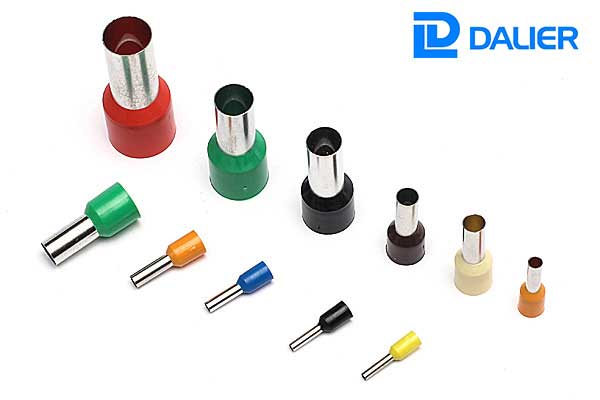
A vinyl‑insulated terminals system from a supplier like Dalier Electric is colour‑coded specifically to prevent that mismatch. The Insulated Cord End Terminal line (the product name for this guide) uses red (0.5‑1.5mm², 19A), blue (1.5‑2.5mm², 27A) and yellow (4‑6mm², 48A) sleeves to signal the correct cable range. This article explains why the wire‑size‑to‑terminal‑rating match matters more than the voltage rating, how the flared PVC funnel sleeve simplifies assembly and prevents strand damage, where the 105°C insulation temperature limit applies, and why the mechanical crimp support on a vinyl terminal matters for high‑vibration industrial panels.
The colour code that warehouse stockers ignore until a line goes down
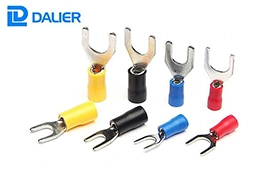
Vinyl‑insulated terminals use a standardised colour code that mirrors the wire gauge convention: red for 22‑16 AWG (0.5‑1.5mm²), blue for 16‑14 AWG (1.5‑2.5mm²) and yellow for 12‑10 AWG (4‑6mm²). Dalier’s insulated cord end terminal line follows that code, with each colour matching a distinct current range:
| Terminal Colour | Cable Size (mm²) | AWG Range | Max Current | Material / Thickness |
|---|---|---|---|---|
| Red | 0.5‑1.5 | 22‑16 | 19A | Purple copper, 0.7‑0.75mm |
| Blue | 1.5‑2.5 | 16‑14 | 27A | Purple copper, 0.8mm |
| Yellow | 4‑6 | 12‑10 | 48A | Purple copper, 1.0mm |
The current ratings (19A for red, 27A for blue, 48A for yellow) are based on the ampacity of the matched wire gauge under normal conditions, not the terminal’s theoretical limit. A common mistake is assuming a yellow terminal rated for 48A can safely be used on 20A 14 AWG wire. It can, electrically, but the oversized barrel will not crimp tightly enough to prevent vibration loosening. Multiple automotive recalls have traced intermittent lamp failures to precisely this mismatch: a yellow terminal on a 16 AWG ground wire that worked fine in the lab but loosened after 5,000 miles of road vibration.
The PVC insulated cord end terminal that stops sparking
The insulation on the Insulated Cord End Terminal from Dalier is a flared polyvinyl chloride (PVC) sleeve. The flare serves a mechanical purpose: it funnels the stripped wire end into the crimp barrel without requiring the operator to precisely align strands. In a high‑volume harness assembly line, that flare cuts insertion time by roughly one second per crimp—a small saving multiplied by hundreds of thousands of units.
The PVC material also provides basic dielectric protection, rated for 600V in most industrial control panel applications. Its temperature limit is 105°C, which covers the vast majority of appliance and automotive under‑hood environments. For applications that exceed 105°C—such as near engine exhaust manifolds—nylon‑insulated or heat‑shrink terminals would be specified.
PVC insulation also provides a degree of chemical resistance to oils, fuels, and mild solvents found in industrial machinery and automotive bays. Dalier’s vinyl insulated terminals are constructed from high‑purity purple copper (copper content exceeding 99.9%) and finished with an electro‑tin plating that resists corrosion in humid environments.
Why the purple copper base metal matters for conductivity
Purple copper (also called oxygen‑free copper) has a conductivity rating of approximately 100% IACS (International Annealed Copper Standard). Some terminal manufacturers use brass (a copper‑zinc alloy), which has a higher hardness but lower conductivity. For a 19A rated terminal, the difference might be acceptable. At 48A, a brass barrel will dissipate more heat as resistive loss than a copper barrel, raising the internal temperature of the terminal and shortening the life of the vinyl sleeve. Dalier’s spec sheet lists the material as “purple copper” for the red, blue, and yellow ranges, with thickness increasing from 0.7mm to 1.0mm as the current rating rises.
Insulated cord end terminals in control panels: the UL 508A requirement
Under UL 508A (the industrial control panel standard), stranded wires terminated directly under screw terminals must be fitted with a ferrule or a properly sized ring terminal to prevent strand‑splaying and loose connections. An insulated cord end terminal acts as a ferrule, compressing the stranded conductor into a solid pin that the screw terminal can clamp without crushing individual strands.
The vinyl sleeve provides strain relief at the point where the wire enters the terminal. Without that support, repeated vibration from contactor operation can work‑harden the copper strands at the insulation‑cut point, causing them to fracture. On a control panel for a HVAC system, that type of failure may take years to develop, but it will eventually cause a phantom open circuit that a technician struggles to trace.
Dalier’s pin terminal variant (PTV series) is designed specifically for this terminal‑block application. The pin end has a smaller diameter than the wire itself, fitting into the cage clamp of a terminal block without requiring a ferrule. The insulation support on the barrel helps prevent wire damage in bending applications, and internal barrel serrations assure good wire contact and maximum tensile strength.
The crimp that a field electrician gets right the first time
A vinyl‑insulated terminal crimp has two distinct sections: the wire crimp that compresses the conductor and the insulation crimp that grips the vinyl sleeve. Field electricians using a cheap ratchet crimper often crush the insulation section, cutting through the PVC and exposing metal — or they miss the insulation section entirely, leaving the sleeve loose.
Dalier’s insulated cord end terminal is designed for a double‑crimp tool with a die that matches the terminal’s geometry. The wire crimp section contains serrations that bite into the copper strands, creating a gas‑tight, low‑resistance connection. The insulation crimp section is longer and shallower, compressing the vinyl without cutting it.
The correct crimp produces a visible indentation on the terminal barrel that follows the die contour. A crimp that is too shallow (common when using an undersized die) may pass a pull‑test but will have higher contact resistance. A crimp that is too deep (using a die intended for non‑insulated terminals) will split the barrel or cut the PVC insulation, creating a future corrosion entry point.
What a field fail looks like six months later
A terminal that was over‑crimped by a field technician using a pliers‑style tool had a hairline crack in the barrel. The crack was invisible to the naked eye. Six months later, vibration had propagated the crack across the barrel width. The wire pulled loose from the terminal, the pump stopped, and the technician spent an hour troubleshooting the intermittent connection before finding the cracked terminal. The crimp tool manufacturer’s “go” gauge would have rejected that crimp at installation, showing that the tool had bottomed out on the die stop.
Three ways a vinyl‑insulated terminal fails that have nothing to do with the metal
Fail one: The wrong colour on the wrong wire
A blue terminal rated for 16‑14 AWG will not seal around 18 AWG wire. The barrel ID is too large, and the crimp tool cannot compress it enough to make solid contact. The result is a mechanically loose connection that heats up under load. The mating cable specification always overrides the terminal’s maximum current rating: a blue terminal on 18 AWG wire is unsafe even if the load is only 10A.
Fail two: Stripping the wire too long
If the wire insulation is stripped back far enough that bare conductor protrudes out the front of the terminal barrel, two failure modes appear. First, the exposed copper can short against adjacent terminals or grounded metal. Second, the terminal’s insulation support does not engage the wire’s outer jacket, so the insulation‑to‑wire joint becomes the bending point, and the conductor work‑hardens and breaks.
Fail three: Using a ratchet crimper that is out of calibration
Crimp tools have a service life. A tool that has completed 50,000 crimps may still close fully and release, but its die alignment may have shifted. The result is a crimp that looks fine but fails a pull‑test at 80% of the rated force. The cost of a new crimper (roughly €100‑200) is trivial compared to a single service call to repair a failed terminal on a production line.
[Image: properly crimped vinyl‑insulated terminal next to three failed crimps: under‑crimped barrel, over‑crimped split barrel, and stripped wire protruding beyond the barrel end]
How the Dalier insulated cord end terminal fits into a facility’s electrical connection strategy
Yueqing Dalier Electric Co., Ltd. manufactures vinyl‑insulated terminals for appliance wiring, industrial control panels, automotive harnesses, and electrical distribution. The company supplies a complete range of vinyl‑insulated connectors: ring terminals, spade terminals, blade terminals, piggyback disconnectors, pin terminals, butt splices, and fully insulated female disconnectors. The Pin Vinyl‑Insulated Terminal series (0.5‑1.5mm², 19A) offers cable size coverage from 0.5mm² to 6mm² across three colours.
The Insulated Cord End Terminal series is produced with high‑precision stamping equipment, maintaining dimensional tolerances that ensure consistent crimp quality across high‑volume production runs. Dalier holds RoHS compliance and offers UL‑listed variants for export markets. The company supplies both bulk pack (100‑500 pieces) and retail packaging for panel builders and OEMs.
For a vinyl‑insulated terminals system that prevents the wire‑gauge mismatch that melted a terminal on an appliance production line, Dalier’s colour‑coded Insulated Cord End Terminal line delivers purple copper conductivity, a flared PVC insertion funnel, 105°C temperature rating, and a crimp geometry that a field technician can get right.
[Request a quote from Dalier Electric]
Contact Dalier Electric with your required wire gauge (AWG or mm²), terminal type (ring, spade, blade, pin, butt splice), and estimated monthly volume for a colour‑coded terminal quotation with matching crimp tool recommendation.