English
 中文
中文 Русский язык
 Français
 Español

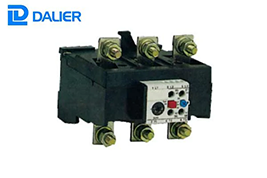
Thermal relay structure
It consists of a heating element, a bimetal, a contact and a set of transmission and adjustment mechanisms. The heating element is a resistance wire with a small resistance value, which is connected in series in the main circuit of the protected motor. The bimetal is formed by rolling two metal sheets of different thermal expansion coefficients. In the bimetal shown in the figure, the lower layer has a large coefficient of thermal expansion and the upper layer is small. When the motor is overloaded, the current passing through the heating element exceeds the setting current, and the bimetal is bent upward and disengaged from the gusset to open the normally closed contact. Since the normally closed contact is connected to the control circuit of the motor, its disconnection causes the contactor coil connected to it to be de-energized, so that the main contact of the contactor is disconnected, and the main circuit of the motor is de-energized, thereby realizing overload. protection.
After the thermal relay is activated, the bimetal is cooled for a while and reset by pressing the reset button.